How a 6-Person Team Shipped an AI-First Platform with KendoReact

Summarize with AI:
For teams building AI-driven applications with complex workflows, treating the UI layer as infrastructure can dramatically reduce friction as the product evolves. For Icanpreneur, KendoReact became that foundation.
Wiring up an LLM endpoint takes an afternoon; the harder engineering problem is building a UI layer that can absorb the inherent unpredictability of AI without introducing layout thrashing, inconsistent interaction patterns or sprawl that a small team can't maintain.
That's the problem Icanpreneur solved with KendoReact.
“The hard part with AI is not just calling a model – it’s designing complex, trustworthy workflows around it. That’s where KendoReact helped a lot.”
Icanpreneur’s platform orchestrates guided, AI-assisted workflows that blend business logic, structured data and real-time feedback into a familiar, approachable experience. Users move through Lean Canvas modeling, validation flows and strategic planning steps with AI augmenting their thinking along the way. They’re now used not only by early-stage founders but also by accelerators, innovation hubs and product teams inside organizations such as Founder Institute, Campus X, Science Park Graz, ABLE Activator, Sofia Tech Park, Visa Innovation Program Europe and Telerik Academy’s Upskill Product Management program.
Raw AI output can be unpredictable. Without a stable, consistent UI foundation, that translates into friction and mistrust. The consistency, predictability and performance of KendoReact in the UI layer turned the output of Icanpreneur’s AI assistant, IVA, into something usable and trustworthy. For Icanpreneur’s six-person team, KendoReact was the infrastructure that made AI usable at scale.
Icanpreneur’s Architecture
At a high level, Icanpreneur’s platform is structured as a layered system that separates UI composition and user interaction, server / API management and LLM orchestration.
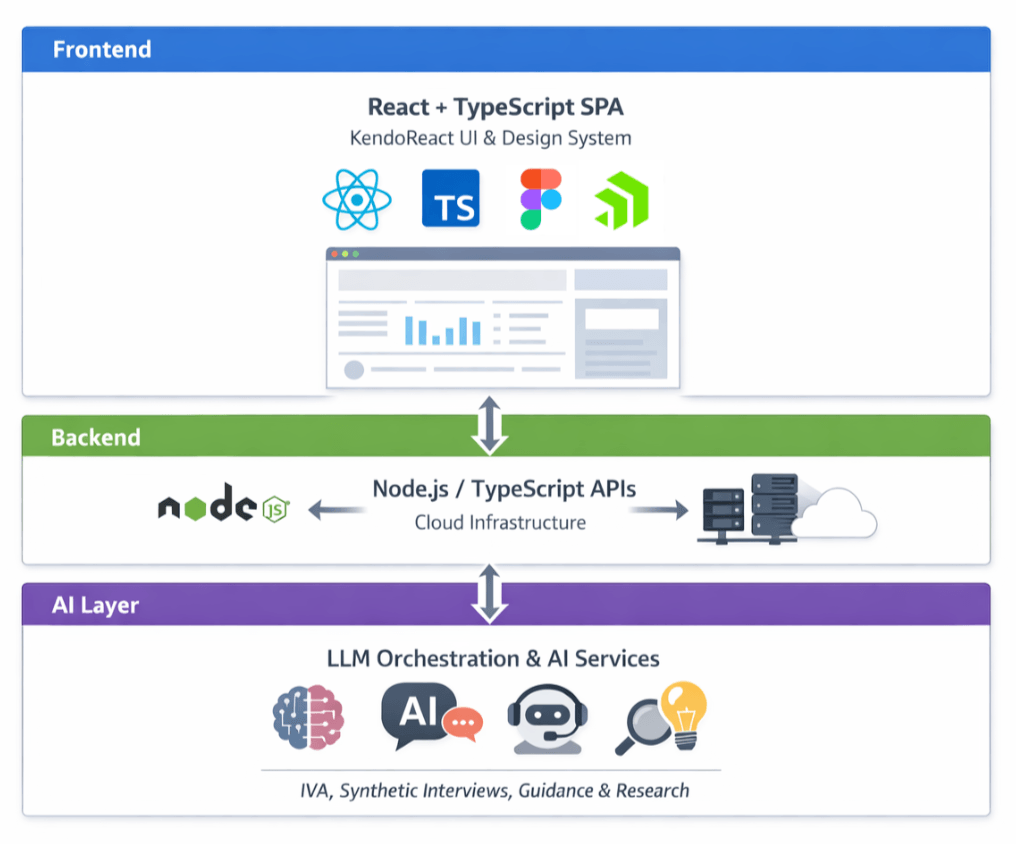
KendoReact is the core of the Icanpreneur UI layer, allowing them to guide users through complex multi-pane screens, support long-running workflows with consistent UI patterns and handle advanced multi-step journeys without overwhelm. Every major module (Lean Canvas, conversational interview console, go-to-market editor, persona builder) is composed from the same KendoReact primitive set, themed consistently and governed by the same layout contracts. That decision paid compounding dividends as the product scaled.
In an AI-first platform, it can be tempting to start thinking about the UI as set dressing; just a thin layer over the APIs to make things “look pretty” for the users. However, AI interaction patterns are still very new and unfamiliar to many users. A UI that naturally folds AI into the user experience can be a real differentiator in the competitive market.
“Founders in partner programs started telling us that the interview, insights and go-to-market flow ‘feels like one tool – simple and intuitive, not five stitched together.'”
AI technology is impressive but UI engineers are still the ones who translate that potential into true value for the user. In Icanpreneur’s case, they needed stable layout primitives, reliable form controls and high-performance data visualization components – all of which had to present AI output reliably (while responses were streaming, partial or evolving) without triggering unnecessary re-renders or layout shifts. KendoReact provided that and more, empowering the team to focus their effort on user experience, business logic and AI orchestration.
Composability as a Force Multiplier
One of the most important architectural decisions was treating KendoReact not as a collection of finished widgets or mere building blocks to be combined but as true UI infrastructure. KendoReact powers everything from research dashboards and conversational interview consoles to mini-CRMs and multi-step go-to-market editors.
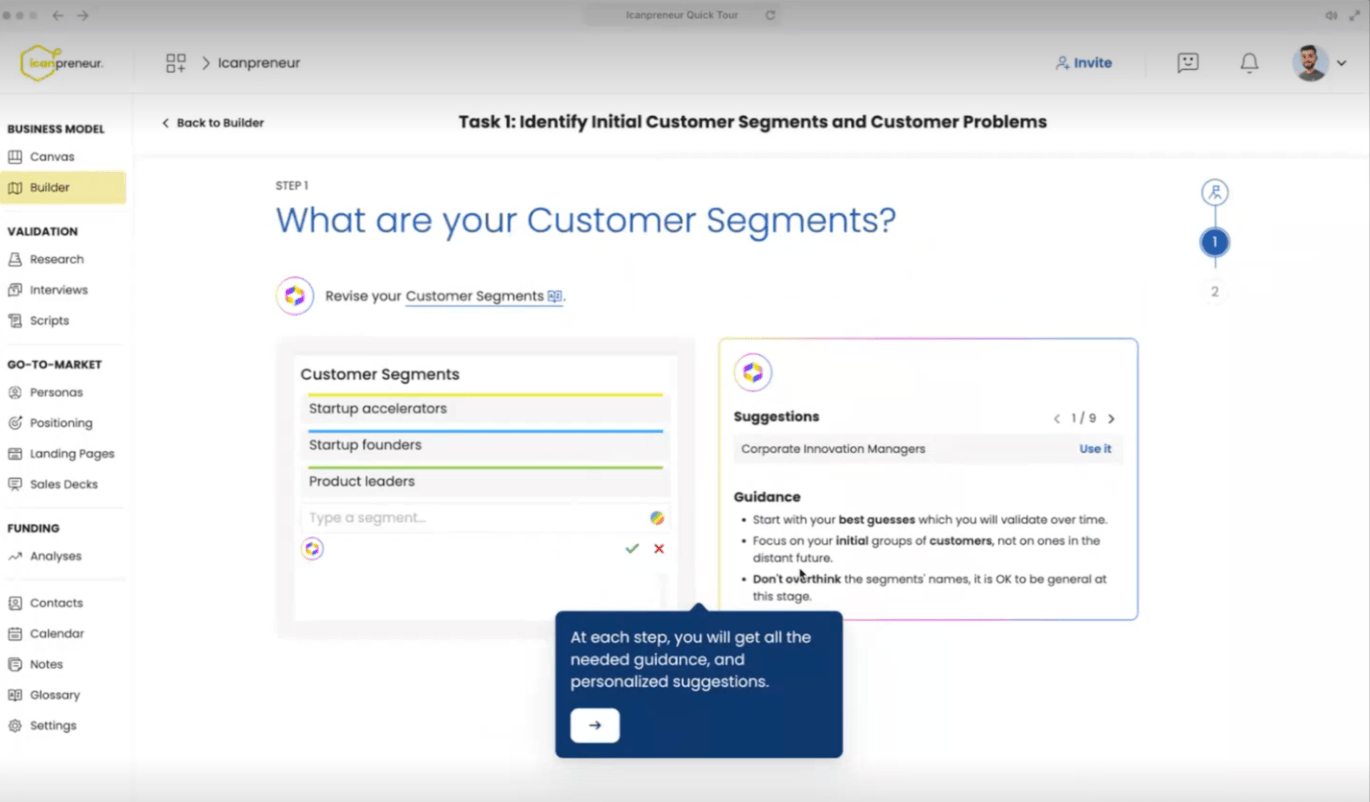
Foundation pieces were combined to create higher-order workflows that guide users through their interactions with IVA. Rather than building custom UI for each flow, the team defined composable patterns built on KendoReact primitives. For example, the multi-step validation flow reused the same layout + navigation structure, AI feedback panels reused consistent container and typography patterns and interview summaries reused standardized layout and card structures. Because the Icanpreneur team didn’t need to design complex new interaction patterns for each additional feature, they were able to implement quickly and iterate fast – smoothly layering their AI workflows on top of KendoReact’s component system.
Consistent UX for Novel AI Workflows
For Icanpreneur users, this meant that they never had to open a page and feel unsure of where to go or what to do next – even though the AI-powered technology may be new, it leveraged familiar and consistent patterns to guide them through the experience.
“Because all the AI-driven experiences reuse the same KendoReact components as the rest of the app, they behave in a predictable way. Users don’t have to ‘learn' a new interface just because AI is involved – it feels like one coherent workspace.”
Design-to-Code Fidelity
With KendoReact, Icanpreneur designers and engineers worked from the same component language, which meant no translation layer between design and implementation, no pixel-chasing and no divergence between what's mocked and what ships. Designers also created a custom design system using the Kendo UI Figma Kits and the Progress Design System Kit, which greatly reduced the time needed to create mockups and new pages.
“Using the Kendo UI Figma Kits and a custom Kendo theme, we aligned design and development from day one. Most new features now start as a quick sketch in our KendoReact-based design system and turn into a working screen in days instead of weeks.”
Increased Development Speed
AI-assisted workflows evolve quickly: new steps get added, feedback formats change and validation criteria expand. Because KendoReact components are extensible and themeable, the Icanpreneur team could meet these challenges while still preserving UX consistency. As workflows grew, the UI layer remained adaptable; less time debugging or re-writing UI logic meant faster revision cycles and more shipped features.
“New workflow-style features (such as a new research flow or AI-assisted editor) now typically go from idea to shipped version in days instead of weeks, because we mostly compose existing KendoReact patterns instead of building UI from scratch.”
The UX of AI
Some of the biggest challenges in AI-first applications are handling uncertainty (usually in the form of partial / still evolving responses) and guiding users through new workflows. The Icanpreneur team leveraged KendoReact’s design tools to create UX patterns that integrate AI feedback into existing, structured UI flows, so users are never left wondering “what now?”.
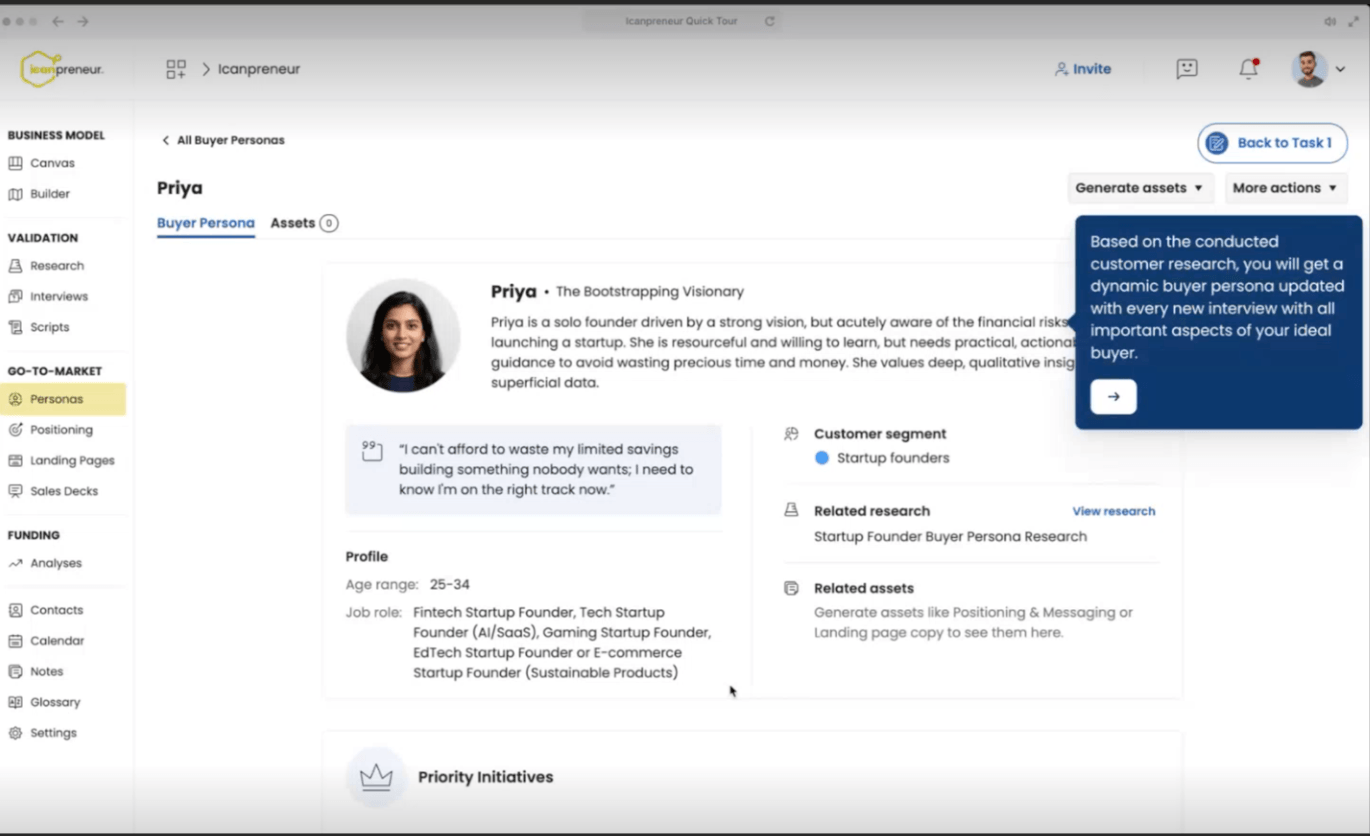
One of the most unique features of Icanpreneur is their Synthetic Customer Interview feature, which allows their AI assistant, IVA, to answer questions as though it was a potential customer in their target market. Not all teams have easy access to customers to run interviews with, so this allows founders to “stress-test” their hypotheses quickly across multiple scenarios. That output helps them refine their questions and assumptions before talking to real people. Afterwards, IVA reviews all the data (across both real and synthetic customer interviews) to summarize, highlight patterns and extract quotes and evidence that can be leveraged in personas and further market research.
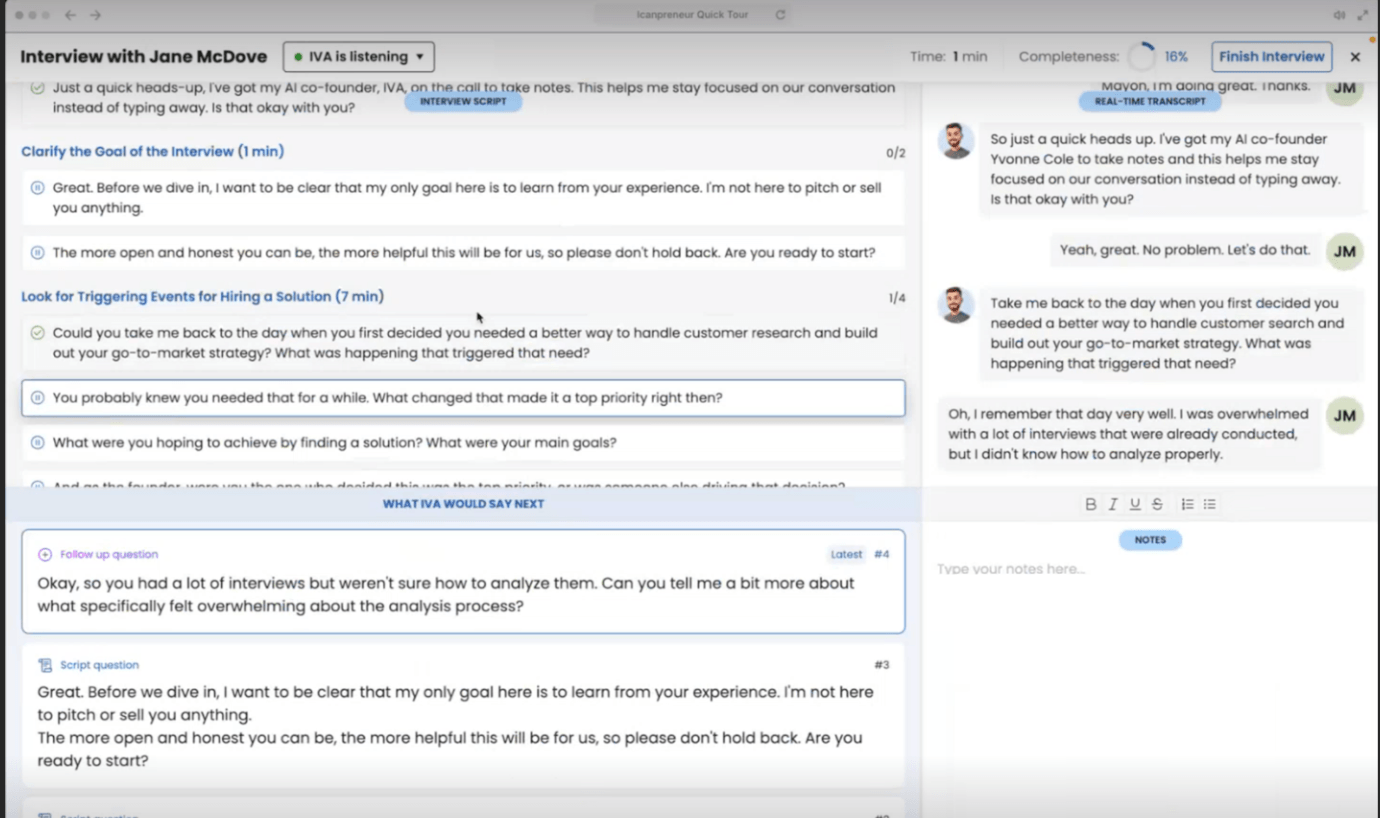
“When we designed IVA, the conversational interview console and the research workspace, we could prototype and ship quickly because we already had chat-style layouts built from existing KendoReact Layout and Form components, multi-step flows for things like research setup and go-to-market editors and reusable Panels, Drawers, Dialogs and Data Grids for displaying AI outputs, suggestions and insights aggregation”
Using KendoReact meant that not only could they leverage these familiar user patterns – but also that common AI concerns (such as slow, partial or unexpected responses) could be handled with UI structures and error responses that users already knew how to interact with.
Performance and Scalability
Icanpreneur workflows are complex, multi-stage journeys. Moving from idea to hypothesis, validating with AI or human-led interviews, identifying patterns and extracting valuable feedback, generating personas and finally creating landing pages or pitch decks – any one of these alone would be demanding but all together they offer a true development challenge. Each step builds upon the previous and the context must be preserved as the user moves between them. Without careful performance engineering, rendering and re-rendering these views would quickly degrade the user experience.
AI workflows can introduce frequent state updates as responses stream in or evolve - for example, when IVA synthesizes interview insights or drafts positioning. In poorly structured UIs, this can lead to layout thrashing or lag. However, these updates render inside structured, well-optimized KendoReact components, so the Icanpreneur UI remains stable.
As features accumulate, custom CSS and one-off component implementations are a common source of bundle bloat and regression risk. At Icanpreneur, new features and modules all plug into the same KendoReact UI system (rather than introducing new patterns and components). That allows even a small team to control UI sprawl and manage bundle growth. Custom CSS – a common pain point for fast-growing applications – is significantly reduced and centralized, because the UI is themed consistently. This kept initial load times reasonable even as the feature surface expanded.
“When we introduce new AI-driven experiences, they use the same KendoReact components, so we see far fewer UI regressions. That made it much easier to roll out new AI features without exploding our QA surface.”
That smaller, bounded QA surface meant faster turnaround and faster time to ship, while the lower complexity means that the small team was able to manage the expedited growth without being overwhelmed. New features that reuse existing KendoReact components inherit known-good behavior, so regression risk didn't scale with feature additions.
KendoReact’s components are designed for high-density, data-heavy enterprise applications; no reinvention (or re-optimization) was required even for complex components like grids, forms and dialogs. KendoReact reduced the need to solve hard performance problems manually, allowing Icanpreneur to access enterprise-level quality with a startup-size team.
Icanpreneur: Powered by KendoReact
Icanpreneur began as a structured way to guide founders from idea to product-market fit. Today it operates as a full AI co-founder, with IVA empowering entrepreneurs to ideate, validate and grow their companies as a trusted partner.
By treating the UI layer as infrastructure and building on KendoReact from day one, the team was able to:
- Scale complex, AI-driven workflows with consistency
- Ship new features rapidly without fragmenting UX
- Deliver a coherent experience across classic and AI-powered screens
For teams building AI-driven workflows, the UI layer is crucial: it's what determines whether AI output becomes a usable, trustworthy product or a source of friction. Icanpreneur's architecture is a case study in treating that layer seriously from day one. Or, as the Icanpreneur team said themselves:
“A six-person core team is able to maintain and evolve a fairly large, AI-first product (research, interviews, personas, positioning, landing pages, sales decks, etc.) without a separate “component team” or design system squad – KendoReact is that system for us.”
For teams building AI-driven applications with complex workflows, treating the UI layer as infrastructure can dramatically reduce friction as the product evolves. For Icanpreneur, KendoReact became that foundation: explore how KendoReact could become that foundation for your team, as well.

Kathryn Grayson Nanz
Kathryn Grayson Nanz is a developer advocate at Progress with a passion for React, UI and design and sharing with the community. She started her career as a graphic designer and was told by her Creative Director to never let anyone find out she could code because she’d be stuck doing it forever. She ignored his warning and has never been happier. You can find her writing, blogging, streaming and tweeting about React, design, UI and more. You can find her at @kathryngrayson on Twitter.
Related Posts
Comments
All articles
Topics
Web MobileMobile
Desktop
Design
Productivity
People