AI Coding Standards and Repeatable Workflows
 by Adam Bertram

Summarize with AI:
Keep AI-generated code consistent across tools with repository instructions, continuous integration checks and pull-request evidence before every merge.
Two pull requests reach the same service. Both are formatted, neatly summarized and passing tests. One used Cursor; the other, Claude Code. Yet your review process cannot show whether either change followed your architecture rules, reused approved helpers or proved the behavior it changed. A clean-looking pull request now hides the work your reviewers still need to verify.
Choosing one approved coding agent may look like the easiest way to restore consistency, but the approved tool will change. Don’t try to control which AI coding tool developers use. Control what every code change is expected to demonstrate before it can be merged.
Your coding standard has to survive the next agent. The useful question is what your review process can prove before merge. The tool can change. The receipt cannot.
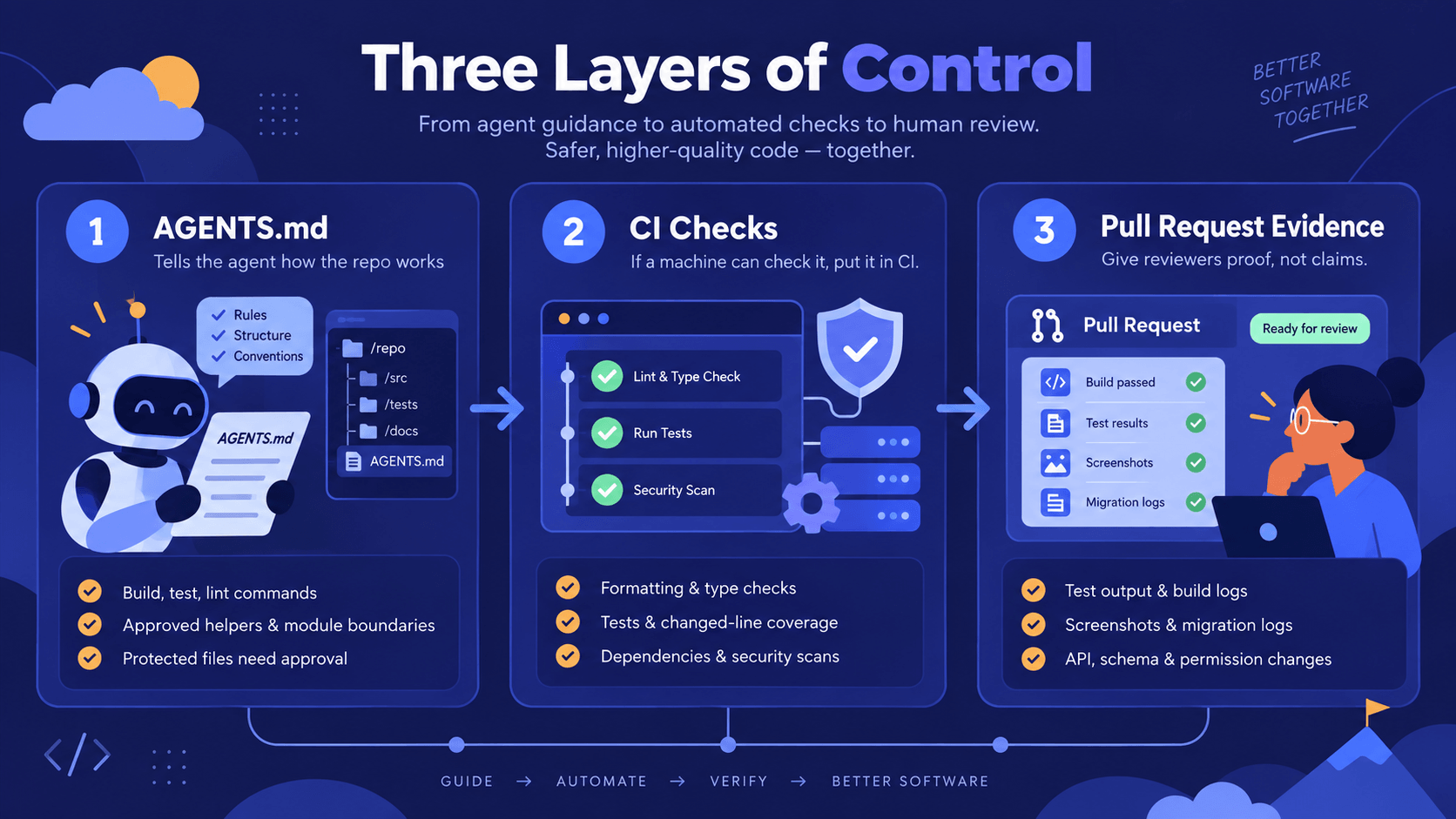
We can use familiar development patterns to build a standard for our AI workflow. Repository-level instructions provide the guidance that gets passed to every agent. Continuous integration checks enforce the standards. Pull requests provide evidence for the human reviewer.
What Your Review Process Was Actually Measuring
Your reviewers once relied on informal signals. Sloppy formatting suggested a rushed change. A 900-line diff with no tests suggested weak scope control. A focused change in your team’s usual style suggested care.
Formatting was a proxy for effort, a focused diff was a proxy for scope control and tests were a proxy for the developer understanding the change. The signals were imperfect, but reviewers knew how to price them in.
AI-generated code breaks the link between polish and care. Polish is no longer a useful indicator of quality. AI can make bad decisions look polished. An agent can produce formatted, confident code that still calls the wrong API, duplicates an existing helper or misses an edge case. A polished diff now tells your reviewers little about whether the underlying choices are sound.
The loss of trust already appears in developer surveys. Stack Overflow’s 2025 developer survey found that 84% of developers use or plan to use AI tools, while 46% distrust the results. Another 45% say debugging AI-generated code takes more time. The survey leaves your review team with an awkward combination of widespread use, low trust and reported debugging overhead.
The Bill Shows Up in Next Year’s Roadmap
Your team sees extra debugging first. Review comments, incidents and rework accumulate when plausible-looking AI-generated code mishandles an edge case or invents an API.
Maintainability debt reaches your roadmap more quietly. Near-matching helpers, copied business rules and one-off implementations make the next change harder.
Your version-control history offers one way to spot maintainability debt. “Moved code” is existing logic that a developer relocates during refactoring instead of duplicating. GitClear’s maintainability research, based on 623 million changes, reports that moved code fell from 21% of changed lines in 2022 to 3.8% so far in 2026, while copy-pasted code rose to 15.7%.
Your velocity dashboard can show that more code shipped while missing the consolidation work that disappeared. AI can increase short-term development speed while quietly increasing long-term maintenance costs.
Five copies of a pricing rule look productive until the rule changes and a developer updates only three. The missing copies turn yesterday’s output into tomorrow’s production incident. Every hour spent tracing those copies comes out of the capacity assigned to next year’s roadmap.
Write the Standard Where the Agents Will Read It
The debugging and duplication problems share one missing control. Your repository does not tell coding agents what “good work” means for the codebase. Useful instructions name the required commands, module boundaries, approved helpers, protected files and review evidence.
Put those instructions at the repository root level, in an AGENTS.md file or similar mechanism. Compatible coding agents then get a predictable place to find repository-specific guidance.
Across your repository fleet, let the platform team own a version-controlled AGENTS.md template for shared security rules, dependency policy and required evidence. Each service team adds local commands, ownership boundaries and architecture rules in its repository copy.
Give each repository’s AGENTS.md a named owner who removes outdated rules as well as adding new ones. Use one placement rule. AGENTS.md holds guidance an agent must interpret; continuous integration (CI) checks hold rules a machine can enforce.
Keep only these items in AGENTS.md.
- The exact build, test and lint commands that CI checks run.
- Local decisions an agent would otherwise guess, such as which module owns persistence or which shared utility already solves a problem.
- Files the agent cannot change without approval, such as generated clients, vendored dependencies, migrations and permission checks.
Let CI Checks Enforce What Prose Can Only Request
Repository instructions guide an agent, but written guidance cannot guarantee compliance. A sentence in AGENTS.md can be misunderstood or ignored. A required CI check can block the merge.
Your CI checks should enforce formatting, strict type checks, tests, changed-lines coverage, dependency allowlists and security scans.
Coverage needs one additional safeguard because an agent can raise the number without proving behavior. Require every meaningful new test to fail against the pre-change code. A pre-change failure gives reviewers evidence that the test exercises changed behavior; reviewers still need to confirm the intended reason for the failure.
Keep the CI evidence after merge because your auditors need it too. NIST’s Secure Software Development Framework organizes secure development into practices, tasks and implementation examples. Test reports, scan results and build artifacts give your auditors timestamped records; a reminder to be careful does not.
Make the Pull Request Carry Its Own Proof
CI checks catch configured rules, but many architecture-fit questions remain reviewer judgments. Polish no longer proves careful work.
Security testing shows the gap between polish and proof. Veracode’s spring 2026 code security update reports that AI coding assistants exceeded 95% syntax correctness while only about 55% of generated samples passed security testing. Code can look finished without being sound.
Because CI checks cannot encode every architecture decision, your pull-request template should require evidence for the remaining judgments.
- Scope. Connect the diff to the ticket and identify unrelated changes.
- Source evidence. Link the documentation or internal standard used for new dependencies, unfamiliar SDK calls and security-sensitive patterns.
- Interfaces. Name any change to a public API, database schema, event schema or permission model, along with the migration or approval record.
- Execution evidence. Attach test output, build logs, scan results, migration logs and screenshots for UI changes.
An AI-written description saying all tests pass is only a claim. When the execution evidence is missing, return the pull request before reviewing the diff.
The Objection, and Where to Start
The strongest objection to repository instructions, CI checks and pull-request evidence is process weight. Safeguards that turn a five-minute change into an hour of gate-clearing invite people to bypass them.
Keep the process light by putting each control in the right place. CI checks own deterministic rules, AGENTS.md owns repository-specific guidance and the pull-request template owns required proof. Human reviewers can then focus on two questions. Does the change fit the architecture, and was the ticket the right change to make?
Start with your highest-traffic repository. Record the rules your reviewers already enforce, move three repeated review comments into CI checks and add evidence fields to the pull-request template. Run the process for two sprints before expanding to another repository.
As you expand the rollout, the instruction format must outlive the current agent. The AGENTS.md format is now stewarded by the Linux Foundation’s Agentic AI Foundation. A durable standard is a system every tool has to survive.
Learn About Progress Forge Orchestration
If you’re ready to move from isolated AI coding tasks to repeatable engineering workflows, Progress Forge (formerly Progress Agent Harness) is designed for exactly that shift. It orchestrates the AI coding agents your team already uses through structured workflows with visibility, governance and human review built in.
Explore the Progress Forge Early Access Program to see how it can help you put these ideas into practice.
Adam Bertram
Adam Bertram is a 25+ year IT veteran, former Microsoft MVP and self-employed consultant who helps organizations replace repetitive manual work with generative AI automation and agent-based workflows. He’s a successful blogger, consultant, trainer, published author and freelance writer for dozens of technology publications.
Related Posts
Comments
All articles
Topics
Web MobileMobile
Desktop
Design
Productivity
People