What’s Next for React in 2026

Summarize with AI:
The State of React survey reveals developer insights into the patterns and tools they use and how their opinions about React are shifting.
The State of React 2025 survey results paint an interesting picture of where React stands as it heads into 2026. React 19 adoption is well underway, but stability hasn’t translated into consensus about what comes next.
What the survey shows is that some of React’s biggest bets are paying off while others are still finding their footing. The patterns we’re building with, the tools we’re reaching for and the way we think about React architecture are all shifting. In this article, we’ll look at what the data actually says and what it means for the year ahead.
React Server Components
One of the most talked about additions to React in the last couple of years has been React Server Components (RSC). Server Components are components that run on the server and let us keep server-only logic, data access and sensitive code out of the client bundle. Alongside that, Server Functions let client-side code invoke server-side logic through a framework-managed interface, without hand-rolling traditional API endpoints for every interaction.
For a great read on Server Components, check out The Current State of React Server Components: A Guide for the Perplexed.
Some have said that Server Components were to be the foundation of React’s next evolution toward a more complete full-stack framework. The survey data, however, is more nuanced.
About 45% of respondents have used Server Components, and among those who have, only about a third report a positive experience. Server Functions tell a similar story, with roughly 37% adoption and 33% positive sentiment among users. In both cases, only a small fraction of the overall community has used these features and come away with a positive sentiment.
Contrast that with Suspense, React’s mechanism for declaratively handling loading states while waiting for asynchronous data or code. Suspense has the highest adoption rate among new features and boasts strong satisfaction numbers.
It’s a useful comparison because it shows that the React community isn’t resistant to new patterns: when a new API solves a clear problem with a reasonable developer experience, adoption follows. With that said, Suspense is a smaller, more contained feature that’s easier to introduce into existing applications, while Server Components require a more fundamental shift in how we think about our application architecture.
The architecture data reinforces this picture. When asked which rendering patterns they’ve used, most teams still rely on the tried-and-true: Single-Page Applications lead the way at 84%, followed by Server-Side Rendering (61%) and Static Site Generation (44%). Newer approaches like partial hydration (25%), streaming SSR (18%) and islands architecture (14%) are gaining traction, but they’re far from mainstream.
None of this means Server Components don’t matter. Architecturally, the ability to move rendering logic to the server, reduce client-side JavaScript and simplify data fetching is significant. But the developer experience may just need more time to mature and catch up to the architectural promise. For most teams, the pragmatic move is to adopt RSC incrementally and where it makes sense, rather than treating it as a mandate to rewrite everything.
What Developers Are Curious About
The survey also gives us a sense of where developer curiosity is headed. The reading list, the section of the survey that lets respondents flag topics they want to learn more about, is a useful signal here.
ViewTransition, a React API for coordinating animated transitions between UI states, ranks near the top. So does Activity, which lets us hide and show parts of our UI while preserving their internal state and DOM. Both are currently only available in React’s Canary channel, but they point to a future where React handles more of the UX polish that we currently rely on third-party libraries for.
What’s worth noting is the general pattern across the survey data. The features gaining the most positive attention tend to be the ones that solve focused problems without requiring a wholesale rethink of how we build applications. Developers are drawn to APIs that slot into their existing workflows and make specific things easier, whether that’s handling loading states with Suspense, coordinating transitions with <ViewTransition> or managing background rendering with <Activity>.
The UI Component Library Landscape
The survey data around UI component libraries also tells an interesting story. The average respondent has used 2.3 UI libraries and a significant proportion don’t use any component library at all. As the survey itself notes, this suggests the space isn’t quite settled yet, and that there’s still room for new entrants to make their mark.
What this tells us is that developers are still actively evaluating their options. Even the most widely used libraries in the survey sit around 50-57% usage, and the libraries with the highest satisfaction rates aren’t always the ones with the broadest adoption. The needs are clear: production-quality components, built-in accessibility, consistent theming, TypeScript support and, increasingly, integration with AI-powered development workflows.
KendoReact
For teams building enterprise applications, the choice of component library has long-term implications. It affects how quickly we can ship features, how accessible our applications are out of the box and how well our UI scales across complex use cases like data grids, schedulers and form-heavy workflows.
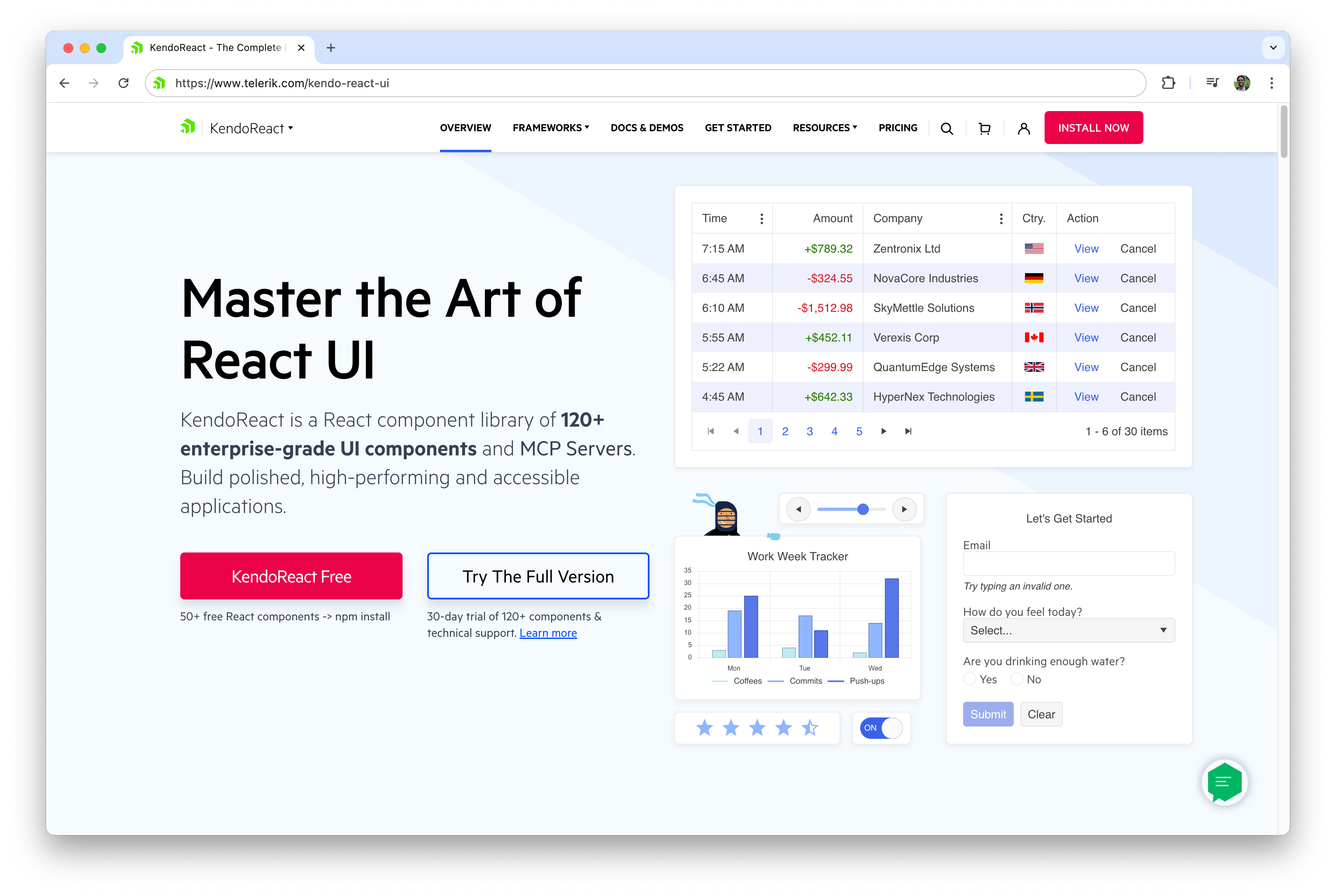
Progress KendoReact is one library worth looking at in this context. It provides 120+ production-ready components with built-in accessibility, deep theming support through ThemeBuilder and recent investments in AI-powered developer tooling including an MCP server and AI coding assistant. For teams evaluating their UI toolkit for the year ahead, it’s a library that’s actively investing in the same directions the ecosystem is moving.
AI as an Accelerator
It would be impossible to write about React development in 2026 without mentioning AI. However, the important thing to keep in mind is that AI is changing how we write React code, not what we build with it.
The AI tooling landscape has shifted significantly over the last couple of years. AI-native editors like Cursor and Claude Code understand our entire codebase and can generate components that match our existing patterns and conventions. Model Context Protocol (MCP) integrations give AI assistants real-time access to component library documentation, so the code they generate actually uses the right props and follows current best practices.
These capabilities make us faster by reducing the time we spend on boilerplate and letting us iterate more quickly. However, they don’t replace the architectural decisions we need to make: when to adopt Server Components, how to structure our state management and which rendering patterns fit our use case. AI accelerates the execution of those decisions, not the decisions themselves.
For a deeper dive into how AI is reshaping day-to-day React workflows, from code generation to theming to agentic development, check out AI Productivity for React Developers in 2026.
What This Means for 2026
The data we surveyed today gives us a clear picture of where React is today and where it could be heading in 2026. React is stable, widely adopted and evolving, but the community’s appetite for significant change is measured.
- Server Components represent React’s most ambitious shift, but mainstream acceptance will take time. For most teams, the winning approach is incremental adoption, where it solves real problems.
- Developer experience still wins. The features seeing the strongest adoption and interest (Suspense, ViewTransition, Activity) solve focused problems without demanding that we rebuild our mental model of React.
- The component library landscape remains unsettled. Teams need libraries that invest in accessibility, developer experience and integrate well with modern tooling, including AI assistants.
- AI is making us more productive at the execution layer, but strategic decisions about architecture and user experience still require human judgment.
Looking ahead, the most successful React teams in 2026 will stay pragmatic: adopting new patterns when they solve real problems, choosing stable tooling and using AI to accelerate delivery without losing sight of fundamentals. React’s ecosystem is mature enough that we can be selective about what we adopt and when.

Hassan Djirdeh
Hassan is a senior frontend engineer and has helped build large production applications at-scale at organizations like Doordash, Instacart and Shopify. Hassan is also a published author and course instructor where he’s helped thousands of students learn in-depth frontend engineering skills like React, Vue, TypeScript and GraphQL.
Related Posts
Comments
All articles
Topics
Web MobileMobile
Desktop
Design
Productivity
People