Binding to ADO.NET Data Service
The purpose of this tutorial is to show you how to populate a RadComboBox with data from an ADO.NET Data Service in two ways:
This tutorial uses the Northwind database.
Before proceeding further with this tutorial you need to create a new application and a RadComboBox declaration in your XAML.
<telerik:RadComboBox x:Name="radComboBox"/>Using Plain Methods Call in the Code-Behind
-
Add a reference to your ADO.NET Data Service.
-
Switch to the code-behind and add a reference to the
NorthwindEntitiesobject.C#NorthwindEntities dbContext = new NorthwindEntities(new Uri("Enter your service address here"));VB.NETDim dbContext As New NorthwindEntities(New Uri("Enter your service address here"))For more information about how to add a reference to an ADO.NET Data Service and how to create a new instance of the exposed entity, take a look at the Consuming ADO.NET Data Service topic.
-
The ComboBoxs control will be populated with all Products from the Northwind database. In the drop-down list the
ProductNameand theUnitPriceproperties will be displayed. Add the following code which will make the initial load of the objects.C#private void BeginRequest() { DataServiceQuery<Products> query = dbContext.CreateQuery<Products>("Products"); query.BeginExecute(RequestCompleted, query); } private void RequestCompleted(IAsyncResult asyncResult) { DataServiceQuery<Products> query = asyncResult.AsyncState as DataServiceQuery<Products>; var products = query.EndExecute(asyncResult).ToList(); this.radComboBox.ItemsSource = products; }VB.NETPrivate Sub BeginRequest() Dim query As DataServiceQuery(Of Products) = dbContext.CreateQuery(Of Products)("Products") query.BeginExecute(RequestCompleted, query) End Sub Private Sub RequestCompleted(ByVal asyncResult As IAsyncResult) Dim query As DataServiceQuery(Of Products) = TryCast(asyncResult.AsyncState, DataServiceQuery(Of Products)) Dim products = query.EndExecute(asyncResult).ToList() Me.radComboBox.ItemsSource = products End SubC#this.radComboBox.ItemsSource = dbContext.Products.Execute();VB.NETMe.radComboBox.ItemsSource = dbContext.Products.Execute() -
You need to declare a custom DataTemplate to determine how the items in the drop-down will look like. Add the following DataTemplate declaration in your XAML resources.
XAML<UserControl.Resources> <DataTemplate x:Key="CustomItemTemplate"> <StackPanel Orientation="Horizontal"> <TextBlock Text="{Binding ProductName}"/> <TextBlock Text=" - "/> <TextBlock Text="{Binding UnitPrice}"/> <TextBlock Text=" $"/> </StackPanel> </DataTemplate> </UserControl.Resources> -
Find your RadComboBox declaration and set the just declared DataTemplate to its ItemTemplate property.
XAML<telerik:RadComboBox ItemTemplate="{StaticResource CustomItemTemplate}"/>
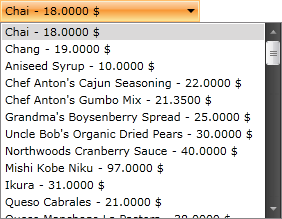
The end result with the data fetched from the service
Using MVVM Approach
This section will show you how to populate your RadComboBox control in a MVVM manner. The ComboBox will be bound to a data source object, that has a property Products. When the control is loaded all products from the Products table in the Northwind database are loaded asynchronously.
-
Create a new class named
NorthwindDataSource.C#public class NorthwindDataSource { private static NorthwindEntities northwindEntity; public NorthwindDataSource() { northwindEntity = new NorthwindEntities(new Uri("Enter your service address here")); this.Products = new ObservableCollection<Products>(); } public ObservableCollection<Products> Products { get; set; } }VB.NETFor Each p As Products In northwindEntity.Products.Execute() Me.Products.Add(p) Next -
Add a reference to your ADO.NET Data Service.
-
In the
NorthwindDataSourceclass add a reference to anObservableCollectionofProduct. -
In the
NorthwindDataSourceclass add a reference to theNorthwindEntitiesobject:C#public class NorthwindDataSource { private static NorthwindEntities northwindEntity; public NorthwindDataSource() { northwindEntity = new NorthwindEntities(new Uri("Enter your service address here")); this.Products = new ObservableCollection<Products>(); } public ObservableCollection<Products> Products { get; set; } }VB.NETFor Each p As Products In northwindEntity.Products.Execute() Me.Products.Add(p) Next -
Add the following code in the constructor of the
NorthwindDataSource. It will make the initial load of all Products from the database:C#public class NorthwindDataSource { private static NorthwindEntities northwindEntity; public NorthwindDataSource() { northwindEntity = new NorthwindEntities(new Uri("Enter your service address here")); this.Products = new ObservableCollection<Products>(); } public ObservableCollection<Products> Products { get; set; } }VB.NETFor Each p As Products In northwindEntity.Products.Execute() Me.Products.Add(p) NextC#public class NorthwindDataSource { private static NorthwindEntities northwindEntity; public NorthwindDataSource() { northwindEntity = new NorthwindEntities(new Uri("Enter your service address here")); this.Products = new ObservableCollection<Products>(); } public ObservableCollection<Products> Products { get; set; } }VB.NETFor Each p As Products In northwindEntity.Products.Execute() Me.Products.Add(p) NextC#public class NorthwindDataSource { private static NorthwindEntities northwindEntity; public NorthwindDataSource() { northwindEntity = new NorthwindEntities(new Uri("Enter your service address here")); this.Products = new ObservableCollection<Products>(); } public ObservableCollection<Products> Products { get; set; } }VB.NETFor Each p As Products In northwindEntity.Products.Execute() Me.Products.Add(p) Next -
Declare the
NorthwindDataSourceobject as a resource in your application.XAML<telerik:RadComboBox ItemsSource="{Binding Source={StaticResource DataSource}, Path=Products}" ItemTemplate="{StaticResource CustomItemTemplate}"/> -
Declare a custom
DataTemplateto determine how the items in the drop-down will look like.XAML<telerik:RadComboBox ItemsSource="{Binding Source={StaticResource DataSource}, Path=Products}" ItemTemplate="{StaticResource CustomItemTemplate}"/> -
Update your
RadComboBoxdeclaration - set theItemsSourceandItemTemplateproperties.XAML<telerik:RadComboBox ItemsSource="{Binding Source={StaticResource DataSource}, Path=Products}" ItemTemplate="{StaticResource CustomItemTemplate}"/>
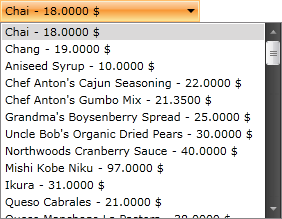
The end result with the data fetched from the service