or
2 answers
124 views
I am trying to build a hiearchical chart and have the following code:
And I get the following error message:
The tag 'ChartHierarchicalViewDescriptor' does not exist in XML namespace 'clr-namespace:Telerik.Windows.Controls;assembly=Telerik.Windows.Controls.Charting'
I looked in your documentation and it is included in that namespace.
<Telerik:RadChart Height="350" x:Name="WeightChart" Width="750"> <Telerik:RadChart.HierarchicalViewDescriptors> <Telerik:ChartHierarchicalViewDescriptor> </Telerik:ChartHierarchicalViewDescriptor> </Telerik:RadChart.HierarchicalViewDescriptors></Telerik:RadChart>And I get the following error message:
The tag 'ChartHierarchicalViewDescriptor' does not exist in XML namespace 'clr-namespace:Telerik.Windows.Controls;assembly=Telerik.Windows.Controls.Charting'
I looked in your documentation and it is included in that namespace.

Giuseppe
Telerik team

answered
on
16 Aug 2011
5 answers
612 views
Because I got stuck I looked at the following example:
http://www.telerik.com/community/forums/wpf/gridview/copying-cell-content-problem.aspx
Using that example: When I go into edit mode for a cell, I can copy the cell's content. When I only select the cell without going into edit mode (still seeing a selection rectangle), it is called three times and in the end copies the entire row to the clipboard.
However, what I want is to copy only the current cell's content to the clipboard without having to go into edit mode (my grid happens to be read only). Bonus: can I get a context menu over the cell for copy? (without too much effort)
Thanks,
Chris
http://www.telerik.com/community/forums/wpf/gridview/copying-cell-content-problem.aspx
Using that example: When I go into edit mode for a cell, I can copy the cell's content. When I only select the cell without going into edit mode (still seeing a selection rectangle), it is called three times and in the end copies the entire row to the clipboard.
However, what I want is to copy only the current cell's content to the clipboard without having to go into edit mode (my grid happens to be read only). Bonus: can I get a context menu over the cell for copy? (without too much effort)
Thanks,
Chris
1 answer
84 views
Hi, I would like to know on how to hide the Timeline, Day and Month Views on the ScheduleView having only the Week View as shown. Thanks
Ayana
Ayana
Kristian
Top achievements
 Rank 1
Rank 1
answered
on
16 Aug 2011
8 answers
179 views
Hi,
I have a question. Why don't the panes with auto hide set on, hide themselves if they have been clicked? A good example is the Telerik Controls Example for Docking. The example called "Unpinned Panes" allows you to hover over different unpinned panes, they animate open and as you move from one pane to the other, other panes open and close as expected. BUT, if you happen to click on one, even moving the mouse to the HostDocument, the panes will no longer auto hide.
This is frustrating, because all 'users' will intuitively click an unpinned menu, perform an action, then click on the Host Document to continue working, even clicking it, but the pane won't auto hide anymore.
Is this a bug, or by design? I hope it's not by design, because it makes using unpinned panes, well... a pain! (pun intended)
Thanks
I have a question. Why don't the panes with auto hide set on, hide themselves if they have been clicked? A good example is the Telerik Controls Example for Docking. The example called "Unpinned Panes" allows you to hover over different unpinned panes, they animate open and as you move from one pane to the other, other panes open and close as expected. BUT, if you happen to click on one, even moving the mouse to the HostDocument, the panes will no longer auto hide.
This is frustrating, because all 'users' will intuitively click an unpinned menu, perform an action, then click on the Host Document to continue working, even clicking it, but the pane won't auto hide anymore.
Is this a bug, or by design? I hope it's not by design, because it makes using unpinned panes, well... a pain! (pun intended)
Thanks
3 answers
409 views
Hi,
In the custom hierarchy demo it shows how to show and hide the expand button during row loaded event. My question is if the users are able to add and remove child rows though the user interface after the gridview is loaded and I don't want to display the expand button if there are no child rows, is there a way to achieve it?
Thanks.
In the custom hierarchy demo it shows how to show and hide the expand button during row loaded event. My question is if the users are able to add and remove child rows though the user interface after the gridview is loaded and I don't want to display the expand button if there are no child rows, is there a way to achieve it?
Thanks.
Vanya Pavlova
Telerik team
answered
on
15 Aug 2011
1 answer
712 views
I'm trying to automatically select the crop tool when an image is loaded. All is ok if I preload the image, but if I allow the user to select the image, I can't seem to find the event that is called after I load up the image to load the tool.
It's probably right in front of me.
Thanks
-Matt
It's probably right in front of me.
Thanks
-Matt
Iva Toteva
Telerik team
answered
on
15 Aug 2011
1 answer
229 views
Hi team,
Actually my requirement is this. I have a set of resources bound to the RadScheduleView. I just want to change the mothview background color based on the resource and number of appointments booked for the day for the particular resource. If no of appointments is below 10 I want to change the monthviewitem background to green and if exceeds 10 it should be red in color. In
RadScheduler I used TimeSlotTemplateSelector to acheive this. I dont know how to do this in scheduleview. Any help....
This is the screenshot...
I marked the area where the background need to be changed...The empty slots are in brown. The slot which has less than 10 appointments are in green and more than 10 appointments are in Red.
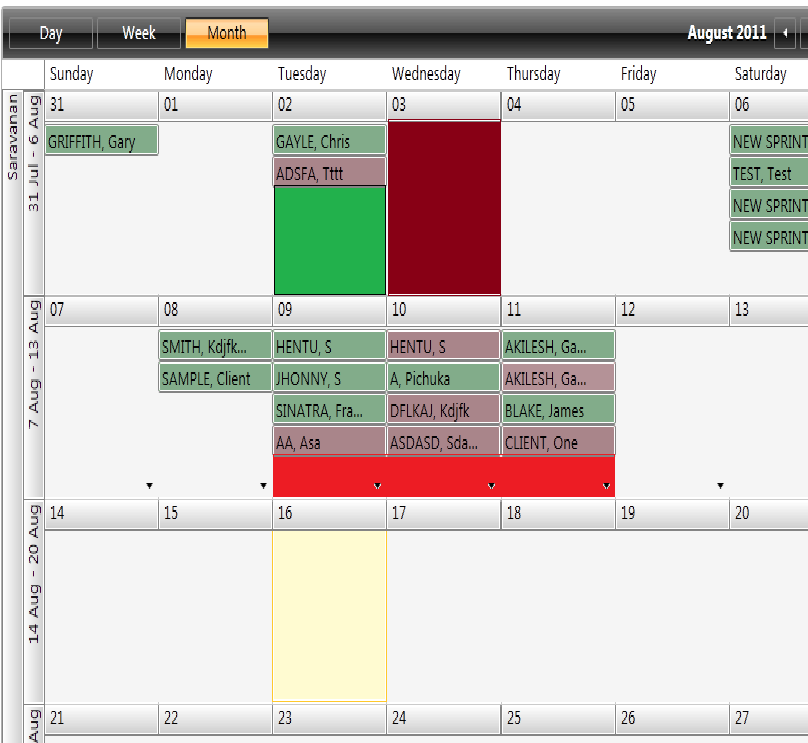
Actually my requirement is this. I have a set of resources bound to the RadScheduleView. I just want to change the mothview background color based on the resource and number of appointments booked for the day for the particular resource. If no of appointments is below 10 I want to change the monthviewitem background to green and if exceeds 10 it should be red in color. In
RadScheduler I used TimeSlotTemplateSelector to acheive this. I dont know how to do this in scheduleview. Any help....
This is the screenshot...
I marked the area where the background need to be changed...The empty slots are in brown. The slot which has less than 10 appointments are in green and more than 10 appointments are in Red.
Konstantina
Telerik team
answered
on
15 Aug 2011
1 answer
62 views
Hi,
Have just upgraded to 2011.2.712.35 and discovered that when I change the content for a grid view by assigning the ItemsSource value, it now collapses all expanded groups. Previously, it would remember which groups the user had expanded and expand them to look the same with the new data.
Is there anyway to configure the behaviour to be like the earlier versions or do I need to go back to 2011.1.419.0.
Best regards,
Russell
Have just upgraded to 2011.2.712.35 and discovered that when I change the content for a grid view by assigning the ItemsSource value, it now collapses all expanded groups. Previously, it would remember which groups the user had expanded and expand them to look the same with the new data.
Is there anyway to configure the behaviour to be like the earlier versions or do I need to go back to 2011.1.419.0.
Best regards,
Russell
Vanya Pavlova
Telerik team
answered
on
15 Aug 2011
1 answer
262 views
I have these two styles defines in separate resourcedictionary files in a separate project:
<Style TargetType="ScrollViewer">
<Setter Property="telerik:StyleManager.Theme" Value="Windows7" />
</Style>
<Style x:Key="ListViewNoHighlightSelection" TargetType="ListView">
<Style.Resources>
<!-- Background of selected item when focussed -->
<SolidColorBrush x:Key="{x:Static SystemColors.HighlightBrushKey}" Color="Transparent" />
<!-- Background of selected item when not focussed -->
<SolidColorBrush x:Key="{x:Static SystemColors.ControlBrushKey}" Color="Transparent" />
</Style.Resources>
</Style>
This is how I use this style:
<Style TargetType="ScrollViewer">
<Setter Property="telerik:StyleManager.Theme" Value="Windows7" />
</Style>
<Style x:Key="ListViewNoHighlightSelection" TargetType="ListView">
<Style.Resources>
<!-- Background of selected item when focussed -->
<SolidColorBrush x:Key="{x:Static SystemColors.HighlightBrushKey}" Color="Transparent" />
<!-- Background of selected item when not focussed -->
<SolidColorBrush x:Key="{x:Static SystemColors.ControlBrushKey}" Color="Transparent" />
</Style.Resources>
</Style>
This is how I use this style:
<ListView x:Name="advertFormatSelector" Grid.Row="0" Grid.Column="0"
Grid.ColumnSpan="7"
Margin="2,2"
BorderThickness="0"
ItemsSource="{Binding BasketItemTemplates}"
SelectedItem="{Binding SelectedBasketItemTemplate, Mode=TwoWay}"
MaxHeight="100"
>
<ListView.Style>
<Style BasedOn="{StaticResource ListViewNoHighlightSelection}"
TargetType="{x:Type ListView}">
<Style.Triggers>
<DataTrigger Binding="{Binding Path=Dimensions}"
Value="{x:Null}">
<Setter Property="BorderBrush"
Value="{StaticResource ErrorBrush}" />
<Setter Property="BorderThickness"
Value="2" />
</DataTrigger>
</Style.Triggers>
</Style>
</ListView.Style>
<ListBox.ItemContainerStyle> .. </ListBoxItemContainerStyle>
<ListView.ItemTemplate>... </ListView.ItemTemplate>
</ListView>
My problem is that the scrollviewer is displayed but it is non-functional (grayed out) since the listview has all the space it needs. I guess showing non-functional scrollbars are part of the theme, but I want no scrollbar when no scrolling is nessesary. I do not want that scrollviewer to be displayed. Adding:
<Setter Property="VerticalScrollBarVisibility" Value="Auto" />
<Setter Property="HorizontalScrollBarVisibility" Value="Auto" />
(or even setting the value to Disabled)
acheives nothing - I've tried to apply these lines to ListViewNoHighlightSelection, to my listview and to its style.
Why do the GUI behave like that and how do I make the scrollbar dissappear ?
Vanya Pavlova
Telerik team
answered
on
15 Aug 2011
1 answer
166 views
I'd like to use a DataTemplateSelector with the RadFluidContentControl. While the RadFluidContentControl exposes SmallContentTemplate, LargeContentTemplate, and ContentTemplate properties, there seems to only be a ContentTemplateSelector property. I'd like to be able to logically determine what template to use for the Large and Small states. Do you have any recommendations?

Petar Mladenov
Telerik team
answered
on
15 Aug 2011