or
0 answers
368 views
12 Oct to 19 Oct 2026: highlights of the new online resources that we published last week.
Article: https://www.telerik.com/products/winforms/documentation/ai-tools/mcp-server/overview
Summary: This overview explains the AI Tools MCP Server for Telerik UI for WinForms and how it exposes your project context and tools to LLM clients using the Model Context Protocol. You’ll see prerequisites and setup steps—installing and starting the server, configuring resources/tools and permissions, and connecting a compatible MCP client—to enable AI-assisted workflows in your WinForms solutions.
Article: https://www.telerik.com/products/winforms/documentation/ai-tools/upgrade-plugin/overview
Summary: This article shows how to use the AI Tools Upgrade Plugin in Telerik UI for WinForms to upgrade projects by scanning your solution, identifying Telerik references (NuGet or local DLLs), and updating them to a selected version with options for backups and change previews. It details prerequisites, supported project types, and a step-by-step workflow in Visual Studio, including guidance for handling API and breaking changes and resolving common upgrade issues.
Article: https://www.telerik.com/products/winforms/documentation/ai-tools/mcp-server/converter/tools
Summary: Learn how to define, validate, and register Tools for the Model Context Protocol (MCP) Server Converter in Telerik UI for WinForms. You’ll configure tool names, descriptions, parameters, and result schemas in JSON, generate tool descriptors, and wire them into your WinForms MCP server so AI Tools can invoke your custom operations, with practical code and JSON examples.
Article: https://www.telerik.com/products/winforms/documentation/ai-tools/mcp-server/upgrade-assistant
Summary: Use this guide to run the Telerik WinForms MCP Server Upgrade Assistant to analyze and upgrade your projects by updating Telerik UI for WinForms references, switching to NuGet packages, and optionally retargeting to newer .NET versions. You’ll follow prerequisites and step-by-step instructions to configure the MCP Server, execute the assistant, choose upgrade options, review diffs, and apply changes safely with backups.
Article: https://www.telerik.com/products/winforms/documentation/ai-tools/mcp-server/converter/overview
Summary: Learn how to use the MCP Server Converter in Telerik UI for WinForms to map .NET types and WinForms data to MCP-compliant JSON payloads and back, so you can expose tools over the Model Context Protocol. This overview covers setup and configuration, the conversion workflow, and how to define mappings, serialization/validation, and error handling when integrating the MCP Server into your WinForms application.
Article: https://www.telerik.com/products/winforms/documentation/ai-tools/mcp-server/coding-assistant/overview
Summary: This overview explains the Coding Assistant for Telerik UI for WinForms and how it uses the MCP (Model Context Protocol) Server to integrate an LLM into your development workflow for context-aware help with controls and code. It details prerequisites and setup (configuring the MCP Server and a supported LLM provider) and shows how to invoke the assistant to generate code snippets, refactor or explain code, and get API usage guidance during WinForms development.
Article: https://www.telerik.com/products/winforms/documentation/ai-tools/mcp-server/converter/getting-started
Summary: This guide shows you how to install, configure, and run the Telerik UI for WinForms MCP Server (Converter) to expose a Model Context Protocol tool that converts standard Windows Forms controls and projects to Telerik RadControls. You’ll set prerequisites, configure project paths and settings, start the server, and connect from an MCP-compatible client to run conversions on individual files or entire solutions.
Article: https://www.telerik.com/products/winforms/documentation/ai-tools/mcp-server/coding-assistant/prompt-library
Summary: Learn how to use the Coding Assistant Prompt Library in the MCP Server for Telerik UI for WinForms to create, organize, and run reusable LLM prompt templates with context variables against selected code, files, or projects. The article explains managing built-in and custom prompts (add, edit, delete, categorize, import/export) and executing them from the Coding Assistant tool window to streamline tasks like code generation, refactoring, and documentation.
Article: https://www.telerik.com/products/winforms/documentation/controls/pdfviewer/customize-and-extensibility/decoding-jpeg2000-images.md
Summary: This article shows how to render JPEG2000 (JPXDecode) images in RadPdfViewer for WinForms by registering a custom image decoder through Telerik’s PdfProcessing extensibility API. It guides you to implement a decoder that converts JPX streams to a bitmap/image, register it so the viewer can decode these images at runtime, and handle scenarios where a JPEG2000 decoder isn’t available.
---------------------------------------------------------------------------------------------------------------------------------------------------------
05 Oct to 12 Oct 2026: highlights of the new online resources that we published last week.
Article: https://www.telerik.com/products/winforms/documentation/ai-coding-assistant/mcp-server/mcp-server
Summary: This article shows you how to set up and run the AI Coding Assistant MCP Server for Telerik UI for WinForms using the Model Context Protocol. It covers prerequisites, installation, configuration (environment variables and ports), starting the server, connecting from an MCP client in your IDE, and the available tools/endpoints with troubleshooting guidance.
Article: https://www.telerik.com/products/winforms/documentation/ai-coding-assistant/upgrade-plugin/overview
Summary: This article shows how to use the AI Coding Assistant Upgrade plugin to update a Telerik UI for WinForms project to a selected target version: it scans your solution for outdated Telerik NuGet packages and deprecated APIs, proposes code changes, and can update project references. You’ll find the prerequisites and steps to run the plugin in Visual Studio, review and apply the suggested changes, and validate the upgrade.
Article: https://www.telerik.com/products/winforms/documentation/controls/gridview/features/data-annotations
Summary: This article explains how RadGridView for WinForms uses System.ComponentModel.DataAnnotations on your model classes to control auto-generated columns and editing behavior when binding to object collections. It details how attributes like Display/DisplayFormat (header text, order, formatting), Browsable/ReadOnly (visibility, editability), and Required/Range/StringLength/RegularExpression (validation) are honored during column generation and cell editing, and outlines the required setup (bind to POCOs and enable auto-generated columns).
Article: https://www.telerik.com/products/winforms/documentation/ai-coding-assistant/mcp-server/upgrade-assistant
Summary: Explains how to configure the Upgrade Assistant MCP Server in the Telerik WinForms AI Coding Assistant so you can run the Microsoft .NET Upgrade Assistant on your WinForms projects directly from the assistant/IDE. Covers prerequisites (dotnet SDK and Upgrade Assistant), installing and starting the MCP server, registering it in the assistant, and running analyze/plan/apply upgrade workflows, with notes on required permissions and troubleshooting.
Article: https://www.telerik.com/products/winforms/documentation/ai-coding-assistant/mcp-server/converter/converter
Summary: This article explains how to use the MCP Server Converter tool to programmatically convert Windows Forms projects by replacing standard WinForms controls with Telerik UI for WinForms equivalents. You’ll see the tool’s request/response schema, supported options (project or solution path, include/exclude filters, dry-run/backup), and example invocations, enabling you to script conversions and review a structured report of changes and issues.
Article: https://www.telerik.com/products/winforms/documentation/knowledge-base/syntaxeditor-create-markdown-tagger
Summary: This article shows you how to build a custom Markdown tagger for the Telerik WinForms RadSyntaxEditor to add Markdown syntax highlighting when no built-in language is available. You implement a tagger that scans the document (e.g., via regex) for headings, emphasis, code blocks, links, and lists, emit classification tags, define corresponding classification types/styles, and register the tagger/provider with the editor so highlighting updates as the text changes.
Article: https://www.telerik.com/products/winforms/documentation/installation-and-upgrades/telerik-cli-migrate-analyzer
Summary: Learn how to use the Telerik CLI Migrate Analyzer to assess a WinForms solution before migrating to Telerik UI for WinForms on .NET (6/7/8). The article shows how to run the analyzer against a solution or project, configure options, and interpret the report to identify incompatible APIs, unsupported controls/features, and problematic references, so you can prioritize fixes and plan a smooth migration.
Article: https://www.telerik.com/products/winforms/documentation/ai-coding-assistant/mcp-server/coding-assistant/overview
Summary: This article outlines the Telerik UI for WinForms Coding Assistant MCP (Model Context Protocol) server, including prerequisites, installation, configuration, and connecting it to an MCP-compatible client. It explains the server’s capabilities—querying WinForms documentation and API references, retrieving examples, and generating code snippets—so you can get context-aware Telerik UI for WinForms assistance directly in your editor.
Article: https://www.telerik.com/products/winforms/documentation/ai-coding-assistant/mcp-server/converter/converter-tools
Summary: Use the AI Coding Assistant MCP server’s Converter tools for Telerik UI for WinForms to convert standard System.Windows.Forms controls to Telerik RadControls and to upgrade projects with the Project Converter. The article documents the available tools, how to invoke them via MCP (tool names, required parameters, arguments, file paths), the expected inputs/outputs, and practical constraints and safeguards to follow during conversion.
Article: https://www.telerik.com/products/winforms/documentation/ai-coding-assistant/mcp-server/coding-assistant/prompt-library
Summary: This article explains how to work with the AI Coding Assistant Prompt Library in the MCP Server for Telerik UI for WinForms: define and organize prompt templates, understand the prompt schema (name, description, role, content, tags, parameters), and use context variables such as selected text and file paths. You’ll learn how to create, edit, and invoke built-in and custom prompts to standardize and reuse instructions across your projects.
---------------------------------------------------------------------------------------------------------------------------------------------------------
14 Sep to 21 Sep 2026: highlights of the new online resources that we published last week.
Article: https://www.telerik.com/products/winforms/documentation/controls/gridview/visual-elements/columns/columns
Summary: Learn how to define and manage RadGridView columns in Telerik UI for WinForms: create and bind built-in types such as GridViewTextBoxColumn, GridViewDecimalColumn, GridViewDateTimeColumn, GridViewCheckBoxColumn, GridViewComboBoxColumn, GridViewImageColumn, GridViewHyperlinkColumn, and GridViewCommandColumn, and configure properties like Name, FieldName, HeaderText, Width, FormatString, ReadOnly, and IsVisible. You will work with the Columns collection, choose between auto-generated and manual columns, apply formatting, and extend functionality with custom columns when needed.
Article: https://www.telerik.com/products/winforms/documentation/controls/ganttview/printing-support/printing-support
Summary: Learn how to print a WinForms RadGanttView by associating it with RadPrintDocument and using the RadPrintPreviewDialog. You’ll wire up the control for printing, configure page settings and scaling (orientation, margins, fit-to-page), and print the task list and timeline with multi-page output as needed.
---------------------------------------------------------------------------------------------------------------------------------------------------------
24 Aug to 31 Aug 2026: highlights of the new online resources that we published last week.
Article: https://www.telerik.com/products/winforms/documentation/installation-and-upgrades/telerik-cli
Summary: Use Telerik CLI to install and upgrade Telerik UI for WinForms from the command line on Windows, macOS, and Linux. This article shows how to install the dotnet global tool, authenticate with your Telerik account or API key, configure the Telerik NuGet feed in nuget.config, and add or update WinForms package references and license keys in your projects. It also outlines how to script these steps for CI/CD to keep dependencies and sources consistent across environments.
Article: https://www.telerik.com/products/winforms/documentation/installation-and-upgrades/installation
Summary: Install Telerik UI for WinForms via the MSI installer: confirm prerequisites, run the setup, select features, integrate with Visual Studio (toolbox and project templates), and optionally configure the private Telerik NuGet feed. The article also explains the installed folder structure and demos and provides guidance for upgrades, including keeping multiple versions side-by-side.
Article: https://www.telerik.com/products/winforms/documentation/installation-and-upgrades/install-using-nuget
Summary: Install and upgrade Telerik UI for WinForms using NuGet: add the Telerik private package source (or a local/offline feed), configure credentials or an API key in Visual Studio or nuget.config, and install packages via the Package Manager UI or the dotnet/nuget CLI. Follow the documented upgrade workflow to update package versions in existing projects and handle scenarios like authenticated feeds, behind‑firewall environments, and local package sources.
Article: https://www.telerik.com/products/winforms/documentation/telerik-presentation-framework/section-508-compliance
Summary: Use the Telerik Presentation Framework for WinForms to meet Section 508 compliance by leveraging its MSAA/UI Automation integration for screen readers, supporting keyboard navigation and Windows High Contrast mode, and setting AccessibleName, AccessibleDescription, and AccessibleRole on RadControls or custom accessible objects. The article explains the accessibility object tree exposed by the framework, shows how to configure and extend accessible metadata for controls and elements, and outlines how to verify compliance with screen readers and contrast testing.
Article: https://www.telerik.com/products/winforms/documentation/visual-studio-integration/migrate-assemblies-to-nuget
Summary: This article shows you how to use the Visual Studio Integration “Migrate Assemblies to NuGet” wizard to convert Telerik UI for WinForms projects from direct DLL/assembly references to NuGet package references. It covers prerequisites and steps: configure and authenticate to the Telerik NuGet feed, select the target version and package source, update references (including theme assemblies) to PackageReference or packages.config, run package restore, and remove obsolete binaries.
Article: https://www.telerik.com/products/winforms/documentation/controls/map/providers/bingmaps/migrating-from-bing-maps
Summary: Learn how to migrate RadMap for WinForms from Bing Maps (BingRestMapProvider) to other supported providers (for example, OpenStreetMap) or a custom XYZ tile provider. You’ll replace the provider in code, remove Bing API key usage, adjust imagery/zoom behavior, handle attribution and terms-of-use, and account for feature differences such as aerial tiles, geocoding/routing, and caching.
Article: https://www.telerik.com/products/winforms/documentation/telerik-presentation-framework/developer-focused-examples
Summary: This article indexes developer-focused examples for the Telerik Presentation Framework (TPF) in WinForms, covering the element tree, property system, layout (measure/arrange), painting primitives, and theming. Use these code samples to build custom RadElement-based controls, extend existing Telerik UI for WinForms components, and apply consistent styling and behavior in your applications.
Article: https://www.telerik.com/products/winforms/documentation/controls/commandbar/how-to/display-calendar-in-dropdown-button
Summary: Learn how to display a RadCalendar in a Telerik WinForms RadCommandBar by attaching a RadDropDownMenu to a CommandBarDropDownButton and hosting the calendar via a RadHostItem. The article outlines creating the menu, adding the calendar, assigning it to the button, and handling calendar selection changes to update the button text and close the drop-down.
---------------------------------------------------------------------------------------------------------------------------------------------------------
10 Aug to 17 Aug 2026: highlights of the new online resources that we published last week.
Article: https://www.telerik.com/products/winforms/documentation/controls/gridview/ai-features
Summary: Learn how to add AI features to Telerik WinForms RadGridView by configuring an LLM provider (OpenAI or Azure OpenAI), enabling the built-in AI prompt UI, and passing grid data or the current selection as context. The article details available commands (e.g., summarize rows, explain a column) and the key APIs/events to customize prompts, control what data is sent, and handle responses in your application.
Article: https://www.telerik.com/products/winforms/documentation/controls/aiprompt/localization
Summary: This article shows how to localize RadAIPrompt in Telerik UI for WinForms by implementing and assigning an AIPromptLocalizationProvider, overriding GetLocalizedString for AIPromptStringId keys (button labels, tooltips, system messages), or by using .resx resource files. It includes the full list of string IDs with default texts and notes on switching CultureInfo/CurrentUICulture at runtime and supporting Right-to-Left layouts.
Article: https://www.telerik.com/products/winforms/documentation/controls/smartpastebutton/overview
Summary: Use the SmartPasteButton control in Telerik UI for WinForms to present users with paste options for clipboard content in your app. You configure the available paste modes (for example, keep formatting or paste as plain text), customize the UI, and handle events/commands to apply the selected mode in your editors or custom controls. The article outlines setup, key properties, and integration patterns so you can wire the control to your paste logic quickly and predictably.
Article: https://www.telerik.com/products/winforms/documentation/controls/smartpastebutton/appearance
Summary: This article shows you how to customize the Telerik WinForms SmartPasteButton appearance using built-in or custom themes (via Visual Style Builder) and element-based styling. You’ll target the control’s element tree to adjust colors, fonts, borders, padding, and state-specific visuals (normal, hover, pressed, disabled), and configure text/image alignment and ThemeName programmatically.
Article: https://www.telerik.com/products/winforms/documentation/controls/smartpastebutton/getting-started
Summary: Set up SmartPasteButton in Telerik UI for WinForms: add the control via the Designer or in code, reference the required assemblies, and initialize it on your form. Link it to the input controls that will receive parsed clipboard data, configure its options, and subscribe to the relevant events to validate and apply results.
Article: https://www.telerik.com/products/winforms/documentation/controls/spreadsheet/features/ai-assistant
Summary: Learn how to enable and configure the AI Assistant in Telerik UI for WinForms RadSpreadsheet so you can connect an AI provider, pass the current selection as context, and apply the response back to cells or ranges. The article covers wiring the service (API keys and model settings), using the ribbon UI, handling prompts and responses programmatically, and implementing a custom provider if you need more control.
Article: https://www.telerik.com/products/winforms/documentation/controls/track-and-status-controls/progressbar/ui-automation
Summary: This article explains the UI Automation support for RadProgressBar in Telerik UI for WinForms, including its ProgressBar control type, exposed automation properties (Name, AutomationId, Minimum, Maximum, Value), and the read-only RangeValuePattern. It shows how to set the control’s accessible/automation name and ID and verify the provider with tools like Inspect to enable reliable UI tests and screen reader support.
---------------------------------------------------------------------------------------------------------------------------------------------------------
08 Jun to 15 Jun 2026: highlights of the new online resources that we published last week.
Article: https://www.telerik.com/products/winforms/documentation/getting-started/telerik-cli
Summary: Learn how to use the Telerik CLI to configure Telerik UI for WinForms from the command line: authenticate, add the private Telerik NuGet source, and install or update the UI for WinForms packages in your .NET WinForms projects. The article provides the exact commands to automate setup and package management for new or existing solutions without relying on Visual Studio extensions.
---------------------------------------------------------------------------------------------------------------------------------------------------------
01 Jun to 08 Jun 2026: highlights of the new online resources that we published last week.
Blog: https://www.telerik.com/blogs/classic-winforms-telerik-minutes-meet-ai-powered-converter
Summary: This article shows you how to use the AI‑assisted Converter to migrate existing Windows Forms (System.Windows.Forms) UIs to Telerik UI for WinForms (RadControls) by analyzing .Designer files and replacing controls while preserving key properties, events and layout. It covers installation in Visual Studio, running the converter at form or project scope, reviewing and reverting changes, supported mappings and known limitations, plus practical guidance on branching, backups and manual verification after conversion.
---------------------------------------------------------------------------------------------------------------------------------------------------------
18 May to 25 May 2026: highlights of the new online resources that we published last week.
Article: https://www.telerik.com/products/winforms/documentation/knowledge-base
Summary: Use the Telerik UI for WinForms Knowledge Base to find targeted how-to articles, troubleshooting guides, and code samples for common control scenarios and issues. Search and filter by control and tag to implement features such as theming, data binding, printing, localization, and performance optimizations, and to resolve known problems. Each article provides step-by-step instructions with C# and often VB.NET snippets you can apply directly in your project.
Article: https://www.telerik.com/products/winforms/documentation/controls/chat/features/replies
Summary: This article shows how to implement Replies in Telerik UI for WinForms RadChat so users can send a new message that quotes and references a specific earlier message. It explains enabling the reply action in the chat UI, programmatically setting and inspecting the replied-to target on outgoing messages, handling send/command events, and customizing or clearing the reply preview.
Article: https://www.telerik.com/products/winforms/documentation/controls/chat/features/toolbar
Summary: This article shows how to enable and customize the Chat toolbar in Telerik UI for WinForms RadChat: show or hide the toolbar, add and reorder items (buttons, toggle buttons, separators), configure text, icons, and tooltips, and apply themes. It also covers wiring item click handlers to execute commands and controlling item visibility and state at runtime through the RadChat API.
Article: https://www.telerik.com/products/winforms/documentation/controls/chat/features/file-upload
Summary: Learn how to enable and customize file upload in the RadChat control for WinForms so users can select files and send them as attachment messages. You’ll use the control’s properties and events to open a file dialog, filter and validate files (by type/size), and handle the selected content for storage or further processing in your application.
Article: https://www.telerik.com/products/winforms/documentation/controls/chat/features/speech-to-text
Summary: You integrate Speech-to-Text with the RadChat control in Telerik UI for WinForms by wiring a speech recognition engine to the chat’s microphone button and sending recognized phrases as messages. The article provides a C# example using System.Speech.Recognition (culture/grammar setup, start/stop, event handlers, UI thread marshaling, error handling) and explains how to plug in alternative engines if required.
Article: https://www.telerik.com/products/winforms/documentation/ai-coding-assistant/converter/converter
Summary: Learn how to use the AI Coding Assistant Converter in Telerik UI for WinForms to translate code snippets between supported languages (such as C# and VB.NET) directly in your project. The article walks you through selecting code, opening the Assistant, choosing Converter and a target language, and inserting or replacing the converted result in the editor, with notes on verifying WinForms-specific APIs and event signatures after conversion.
Article: https://www.telerik.com/products/winforms/documentation/controls/chat/features/multi-line-editor
Summary: This article shows how to configure the RadChat input area in Telerik UI for WinForms to act as a multi-line editor. You’ll enable line breaks, control Enter key behavior (send vs insert new line), adjust auto-resize and maximum height, and access the underlying input element for customization and key handling.
Article: https://www.telerik.com/products/winforms/documentation/ai-coding-assistant/coding-assistant/overview
Summary: Learn how to enable and configure the Telerik UI for WinForms AI Coding Assistant in Visual Studio, including setting up your OpenAI or Azure OpenAI connection and choosing models. You’ll use it to prompt, generate, refactor, and explain C# or VB.NET code for Telerik WinForms controls, then insert or copy results into your project. The article outlines prerequisites, supported providers and languages, available options for prompt context, and data usage considerations.
Article: https://www.telerik.com/products/winforms/documentation/ai-coding-assistant/converter/converter-tools
Summary: This article explains how to use the AI Coding Assistant Converter tools in Telerik UI for WinForms to perform language and control conversions and assist with migrating standard WinForms code to Telerik components. It lists the available converters, how to access them, supported inputs/outputs (code snippets and designer code), and how to preview and apply results to your project, with notes on prerequisites, limitations, and review tips.
Article: https://www.telerik.com/products/winforms/documentation/ai-coding-assistant/coding-assistant/prompt-library
Summary: This article explains the Prompt Library in the Telerik UI for WinForms AI Coding Assistant and shows how to create, edit, clone, delete, and organize reusable prompt templates. You learn how to use context placeholders (for example, selected code, active document, project/solution, clipboard), import/export prompt collections, and run templates from the Coding Assistant panel or editor context menu to automate tasks like explaining, refactoring, and generating comments or tests.
---------------------------------------------------------------------------------------------------------------------------------------------------------
11 May to 18 May 2026: highlights of the new online resources that we published last week.
Article: https://www.telerik.com/products/winforms/documentation/controls/pivotgrid/custom-group-comparer
Summary: This article shows how to control the ordering of row and column groups in Telerik UI for WinForms RadPivotGrid by using a custom group comparer. You implement IComparer
Article: https://www.telerik.com/products/winforms/documentation/controls/editors/datetimepicker/providers
Summary: This article explains the provider layer behind Telerik WinForms RadDateTimePicker and how it controls parsing, formatting, and editing of date and time input. It shows how to select and configure built-in providers, and how to assign or implement a custom provider to control culture-aware formats, null handling, min/max validation, and spin/keyboard behavior.
Article: https://www.telerik.com/products/winforms/documentation/knowledge-base/syntaxeditor-selected-line-border
Summary: Learn how to draw a border around the selected line in RadSyntaxEditor for WinForms by adding a custom UI layer that computes the selected line’s layout bounds and renders an outline. The article shows how to hook the layer into the editor, listen for selection/caret changes to invalidate and redraw, and map selection spans to view line rectangles to handle single- and multi-line selections and word wrap.
Article: https://www.telerik.com/products/winforms/documentation/knowledge-base/syntaxeditor-execution-line-highlight
Summary: Learn how to implement an execution line highlight in Telerik WinForms RadSyntaxEditor, similar to a debugger’s current-line background. The article shows how to add a custom UI layer that draws a full-width line highlight for a specified line index and how to update, invalidate, and repaint the highlight in response to caret moves, line changes, edits, and scrolling. This enables programmatic control over the highlighted line to reflect the current execution point.
Article: https://www.telerik.com/products/winforms/documentation/knowledge-base/syntaxeditor-highlight-current-line-number
Summary: Learn how to highlight the current line number in Telerik WinForms RadSyntaxEditor by custom painting the line-number margin based on the caret line. You’ll subscribe to caret and viewport change events, compute the current line index, render that line number with a distinct style, and invalidate only the margin region for efficient updates.
Article: https://www.telerik.com/products/winforms/documentation/knowledge-base/pivotgrid-calculated-item-dynamic-group-names
Summary: Learn how to create and maintain a RadPivotGrid (WinForms) calculated item that references groups whose captions change at runtime (for example, Year/Quarter groups). The article shows how to programmatically build the calculated item expression from the current row/column group captions and update both the caption and formula on pivot layout changes, ensuring the calculation resolves correctly with dynamic group names.
Article: https://www.telerik.com/products/winforms/documentation/controls/scheduler/print-support/print-settings-dialog-factory
Summary: This article shows you how to replace or customize the RadScheduler print settings dialog in WinForms by implementing IPrintSettingsDialogFactory and assigning your implementation to the RadScheduler.PrintSettingsDialogFactory property. You create a custom dialog (typically derived from the built-in scheduler print settings dialog) to control available printing options—such as date range, styles, headers/footers—and integrate it into the scheduler’s printing workflow.
Article: https://www.telerik.com/products/winforms/documentation/controls/gridview/features/editing/expression-editor/expression-syntax
Summary: This article documents the expression syntax for Telerik UI for WinForms RadGridView, used in the Expression Editor and GridViewExpressionColumn to define calculated fields. It explains how to reference columns with [ColumnName], use numeric/string/date-time literals, and combine arithmetic, comparison, and logical operators with correct precedence, plus the available functions, naming/escaping rules, and null handling. Use it as a reference when creating totals, conditional values, or other computed expressions at design time or runtime.
Article: https://www.telerik.com/products/winforms/documentation/controls/gridview/features/editing/expression-editor/functions-reference
Summary: This article lists and explains all functions supported by the RadGridView Expression Editor in Telerik UI for WinForms, including syntax, return types, and examples. Use it to compose and debug expressions for calculated/unbound columns, filtering, grouping, sorting, and conditional formatting, covering math, string, date/time, logical, aggregate, conversion, and null-handling functions, plus notes on operators and culture-sensitive behavior.
Article: https://www.telerik.com/products/winforms/documentation/controls/gridview/features/printing-support/print-settings-dialog-factory
Summary: This article shows how to replace and customize the RadGridView print settings UI in Telerik UI for WinForms by supplying a custom factory for RadPrintSettingsDialog via radGridView.PrintStyle.PrintSettingsDialogFactory. You implement a factory that returns your dialog (e.g., to hide or preset options, localize text, or enforce GridViewPrintStyle defaults) and assign it before invoking PrintPreview or Print to control the printing experience.
---------------------------------------------------------------------------------------------------------------------------------------------------------
13 Apr to 20 Apr 2026: highlights of the new online resources that we published last week.
Article: https://www.telerik.com/products/winforms/documentation/controls/forms-and-dialogs/form/ui-automation
Summary: This article explains how RadForm participates in Microsoft UI Automation (UIA) in Telerik UI for WinForms, including the UIA properties and the Window pattern it exposes. It shows how to set AccessibleName, AccessibleDescription, AccessibleRole, and Text to produce correct automation names for screen readers and automated tests, and how to verify the output with tools like Inspect or Narrator. Use this to configure RadForm for accessible UI and reliable UI automation.
Article: https://www.telerik.com/products/winforms/documentation/controls/panels-and-labels/panel/ui-automation
Summary: This article documents RadPanel’s Microsoft UI Automation support in Telerik UI for WinForms, including its UIA control type (Pane), the provider properties it exposes (e.g., Name from AccessibleName, IsEnabled, BoundingRectangle), and the UIA patterns it implements for accessibility and test automation. It also shows how RadPanel and its children appear in the UIA tree, how to set AccessibleName/AccessibleDescription/AccessibleRole to surface the right metadata, and how to validate the result with Inspect or Accessibility Insights.
Article: https://www.telerik.com/products/winforms/documentation/controls/forms-and-dialogs/radtitlebar/ui-automation
Summary: Learn how RadTitleBar in Telerik UI for WinForms is exposed to Microsoft UI Automation, including the automation tree, ControlType (TitleBar), Name/AutomationId, and supported patterns for caption buttons (Invoke on Minimize, Maximize/Restore, and Close). Use this to reliably locate and interact with the title bar and its child elements in Inspect and in accessibility or UI test automation.
---------------------------------------------------------------------------------------------------------------------------------------------------------
16 Mar to 23 Mar 2026: highlights of the new online resources that we published last week.
Article: https://www.telerik.com/products/winforms/documentation/knowledge-base/scheduler-print-24-hour-format
Summary: This article shows how to print RadScheduler (Telerik UI for WinForms) with 24-hour time (HH:mm) instead of the default 12-hour/AM/PM format. It demonstrates configuring the printing pipeline by customizing the scheduler print style to format time labels with a 24-hour pattern, or by applying a culture that uses 24-hour time, and provides the code to apply these changes before print or print preview.
Article: https://www.telerik.com/products/winforms/documentation/knowledge-base/dock-custom-context-menu-documentwindow
Summary: Learn how to replace the default context menu for RadDock DocumentWindow in Telerik UI for WinForms with your own RadContextMenu. You intercept right-clicks on document tabs/windows, suppress the built-in menu, resolve the clicked DocumentWindow, and show a custom menu wired to actions like Close, Close All, or your own commands.
Article: https://www.telerik.com/products/winforms/documentation/knowledge-base/richtexteditor-align-table-cell-content
Summary: This article shows how to align table cell content in Telerik UI for WinForms RadRichTextEditor using the document model API: set Paragraph.TextAlignment for horizontal text alignment and TableCell.VerticalAlignment for vertical alignment. It provides C# examples for iterating cells (from the current selection or an entire table) and applying these settings programmatically.
---------------------------------------------------------------------------------------------------------------------------------------------------------
09 Mar to 16 Mar 2026: highlights of the new online resources that we published last week.
Article: https://www.telerik.com/products/winforms/documentation/knowledge-base/syntaxeditor-collapse-expand-nodes
Summary: Learn how to programmatically collapse and expand code folding (outlining) regions in RadSyntaxEditor for WinForms using C#. You’ll access the editor’s folding/outlining tagger to toggle specific regions by span or line and implement Collapse All / Expand All so the editor UI updates correctly.
---------------------------------------------------------------------------------------------------------------------------------------------------------
09 Feb to 16 Feb 2026: highlights of the new online resources that we published last week.
Article: https://www.telerik.com/products/winforms/documentation/controls/speechtotextbutton/events
Summary: This page details the SpeechToTextButton events in Telerik UI for WinForms and when they fire throughout the speech recognition lifecycle (listening started/stopped, partial/interim results, final result, and errors). Use these events to subscribe handlers that capture transcripts, inspect event args for text, confidence, and exceptions, and update your UI and logic as the button toggles between idle and recording.
Article: https://www.telerik.com/products/winforms/documentation/controls/speechtotextbutton/states
Summary: This article explains the visual and functional states of the WinForms SpeechToTextButton (e.g., Idle, Listening, Processing, Disabled) and how each state affects the button’s appearance and behavior. You learn how to start/stop listening, query and change the current state programmatically, and handle state-change events to update your UI. It also outlines where to customize state indicators and styles through theming.
Article: https://www.telerik.com/products/winforms/documentation/controls/speechtotextbutton/overview
Summary: Learn how to use the RadSpeechToTextButton control in Telerik UI for WinForms to start/stop speech recognition from a microphone and insert transcribed text into a target input control (such as a text box). The article shows how to add the control, configure the target control and recognition settings (e.g., culture/grammars), and handle recognition lifecycle and error events, plus prerequisites like an available microphone and enabled Windows speech recognition.
Article: https://www.telerik.com/products/winforms/documentation/controls/speechtotextbutton/appearance
Summary: This article shows you how to style the SpeechToTextButton control in Telerik UI for WinForms: apply built-in themes (via ThemeName or ThemeResolutionService) and customize the visual tree with Visual Style Builder. You’ll adjust text/image layout (e.g., TextImageRelation and ImageAlignment), replace the microphone icons for different states, and tweak colors, borders, and fonts, including how to override theme values when setting appearance at runtime.
Article: https://www.telerik.com/products/winforms/documentation/controls/map/features/transparency-tiles
Summary: This article explains how RadMap for WinForms renders transparent map tiles (PNG alpha) and how to use them to build hybrid maps by layering a transparent tiles source (e.g., labels/roads) over a base imagery provider. It shows how to configure layer order and background to make transparency useful and outlines considerations when mixing tile providers that return transparent tiles.
Article: https://www.telerik.com/products/winforms/documentation/controls/speechtotextbutton/getting-started
Summary: Learn how to add and configure the SpeechToTextButton (RadSpeechToTextButton) in Telerik UI for WinForms to capture microphone input and populate a text control. You’ll add the control via the Designer or code, set the target text box, choose the recognition language/culture and input device, start/stop recognition, and handle recognition and error events to process results reliably.
Article: https://www.telerik.com/products/winforms/documentation/controls/speechtotextbutton/custom-recognizer
Summary: This article shows how to integrate a custom speech recognition engine with the WinForms SpeechToTextButton by implementing the control’s recognizer interface and wiring your implementation to the button. It outlines the required contract (start/stop/cancel operations, partial and final result events, state changes, and error reporting) and demonstrates attaching your recognizer so the button controls recognition, updates its state, and outputs recognized text using services like Azure, Google, Amazon, or on‑prem engines.
---------------------------------------------------------------------------------------------------------------------------------------------------------
12 Jan to 19 Jan 2026: highlights of the new online resources that we published last week.
Article: https://www.telerik.com/products/winforms/documentation/knowledge-base/gridview-tracking-visible-rows
Summary: Learn how to detect which data rows are currently visible in RadGridView for WinForms, taking virtualization, scrolling, filtering, and grouping into account. The article shows two approaches: compute the visible range using the table element’s RowScroller (vertical scrollbar value and viewport size), and enumerate the currently realized GridDataRowElement instances to access their RowInfo/DataBoundItem, with examples wired to scroll and resize events.
Article: https://www.telerik.com/products/winforms/documentation/knowledge-base/gridview-export-groups-collapsed
Summary: Learn how to export a grouped WinForms RadGridView to Excel (XLSX) with all groups collapsed on open using GridViewSpreadExport. You handle the exporter’s WorkbookCreated callback and set each worksheet RowGroup to collapsed (e.g., iterate Worksheet.RowGroups and set IsCollapsed = true) so the resulting file preserves the collapsed state of the grid’s groups. Note: this behavior relies on SpreadExport (XLSX); the older ExcelML exporter cannot persist collapsed outline groups.
Article: https://www.telerik.com/products/winforms/documentation/knowledge-base/listview-custom-item-arrangeoverride
Summary: This article shows you how to create a custom RadListView visual item in Telerik UI for WinForms and precisely control its layout by overriding ArrangeOverride (and MeasureOverride). You’ll subclass SimpleListViewVisualItem/BaseListViewVisualItem, add child LightVisualElement elements (e.g., image and text) in CreateChildElements, compute and assign bounds in ArrangeOverride, and plug your item in via the VisualItemCreating event to achieve custom item layouts.
Article: https://www.telerik.com/products/winforms/documentation/knowledge-base/autocompletebox-remove-duplicate-text
Summary: This article shows how to remove duplicate text in Telerik UI for WinForms RadAutoCompleteBox by preventing duplicate tokens and sanitizing pasted, delimiter-separated input. You validate each new entry against the existing Tokens collection (case-insensitive) and either cancel the duplicate or rebuild the text from unique values to keep the control’s content deduplicated.
Article: https://www.telerik.com/products/winforms/documentation/knowledge-base/datetimepicker-custom-freeform-parser
Summary: Learn how to add a custom free‑form date/time parser to Telerik WinForms RadDateTimePicker so users can type dates in multiple formats (e.g., 1/2, 2024-01-02, 2pm) and still produce a valid Value. You’ll intercept the editor’s TextChanging/ValueChanging flow, parse with DateTime.TryParse/TryParseExact using defined patterns and CultureInfo, cancel the default parsing, set the normalized DateTime, and surface validation when parsing fails.
Article: https://www.telerik.com/products/winforms/documentation/knowledge-base/diagram-enable-autoscroll-dragging-shape
Summary: Enable auto-scroll in Telerik UI for WinForms RadDiagram while you drag a shape, so the canvas pans when the pointer nears the control edges. You’ll handle the drag operation to detect edge proximity and programmatically scroll the viewport (via the control’s scrollbars), with adjustable edge thresholds and scroll step to tune speed and responsiveness.
---------------------------------------------------------------------------------------------------------------------------------------------------------
05 Jan to 12 Jan 2026: highlights of the new online resources that we published last week.
Article: https://www.telerik.com/products/winforms/documentation/introduction
Summary: This introduction explains what Telerik UI for WinForms includes and which .NET/Windows targets it supports, covering theming, high DPI, localization, RTL, accessibility, and touch. Use it to install the controls from the Telerik NuGet feed or the installer, set up Visual Studio design-time, and navigate to getting started, API reference, and guides for core controls like RadGridView, ChartView, Scheduler, Ribbon, Dock, PDF Viewer, and RichTextEditor, plus theming and upgrade guidance.
Article: https://www.telerik.com/products/winforms/documentation/security/faq
Summary: This Security FAQ explains how Telerik UI for WinForms handles key security topics: assembly/code signing, third‑party dependencies and CVE monitoring, telemetry/data collection, network behavior, and operation under restricted permissions (including FIPS or locked‑down environments). It also details the vulnerability reporting and patching process and provides guidance to help you securely use, configure, and update the controls in your WinForms applications.
Article: https://www.telerik.com/products/winforms/documentation/core/overview
Summary: This overview explains how to use Telerik UI for WinForms with .NET Core and .NET 5/6/7/8 on Windows, including supported runtimes, Visual Studio and Windows Forms Designer requirements, and toolbox integration. You’ll learn how to create or migrate SDK-style WinForms projects, reference the correct .NET-targeted assemblies via NuGet or local binaries, and handle build/deploy specifics, with notes on platform limitations and known issues.
Article: https://www.telerik.com/products/winforms/documentation/knowledge-base
Summary: Use the Telerik UI for WinForms Knowledge Base to find troubleshooting guides, how-to articles, and code examples for common control scenarios such as GridView, data binding, theming, printing, and performance. Search and filter the articles to quickly locate task-focused solutions you can apply directly in your project to fix issues or implement features. Each entry summarizes the problem context and provides the steps or code needed to resolve it.
Article: https://www.telerik.com/products/winforms/documentation/core/design-time
Summary: This article explains design-time support for Telerik UI for WinForms when targeting .NET Core and .NET 5/6/7 in the Visual Studio Windows Forms Designer. You’ll verify prerequisites, install/reference the Telerik assemblies via NuGet, integrate controls into the Toolbox, and use designer features like smart tags, themes, and the Property Grid. It also outlines known limitations of the .NET Core designer and provides troubleshooting guidance.
Article: https://www.telerik.com/products/winforms/documentation/security/overview
Summary: This article explains how to secure applications built with Telerik UI for WinForms and what you are responsible for: ship official strong‑named assemblies, keep the suite updated, run with least privilege, and treat all data bound to controls as untrusted. It outlines best practices for controls that load files or markup (document viewers/editors), including validating and sanitizing input, restricting or disabling external resource loading and hyperlink actions, and avoiding deserialization of untrusted content, and it points you to the product’s vulnerability reporting and support policies.
Article: https://www.telerik.com/products/winforms/documentation/tools/themeviewer
Summary: This article explains how to use the ThemeViewer to preview and validate Telerik UI for WinForms themes across the control suite. You load built-in or custom themes (including ones created with Visual Style Builder), switch between controls and states, and test scenarios like DPI scaling and RightToLeft to catch visual issues before integrating a theme into your application.
Article: https://www.telerik.com/products/winforms/documentation/core/core-migration
Summary: This guide shows you how to migrate a Telerik UI for WinForms app from .NET Framework to .NET (Core/.NET 5+), either by converting the existing project to SDK-style or by creating a new .NET WinForms project and moving your code. You’ll retarget the TFM and replace assembly references with the Telerik .NET packages from the Telerik NuGet feed, then rebuild. It also covers resource/settings handling (resx, app.config via System.Configuration.ConfigurationManager), WinForms designer requirements in Visual Studio, publishing, and common fixes such as adding Microsoft.Windows.Compatibility, resolving missing APIs, licensing considerations, and 32/64-bit differences.
Article: https://www.telerik.com/products/winforms/documentation/controls/clock/clock
Summary: Use RadClock (Telerik UI for WinForms) to show an analog clock and optionally let users pick a time; this article shows how to add the control in the designer or code, set the time via the Value (DateTime) property, and handle ValueChanged. It also details appearance and behavior settings, theming, and embedding RadClock in RadTimePicker.
Article: https://www.telerik.com/products/winforms/documentation/controls/chat/toolbar
Summary: This article shows you how to configure the RadChat toolbar in Telerik UI for WinForms: enable/disable the toolbar, add and arrange toolbar items, and control their visibility. You’ll create toolbar items, handle click events, and customize icons, tooltips, and layout to add actions (for example, attachments or emoji) next to the chat input.
---------------------------------------------------------------------------------------------------------------------------------------------------------
10 Nov to 17 Nov 2025: highlights of the new online resources that we published last week.
Article: https://docs.telerik.com/devtools/winforms/knowledge-base/add-license-key-in-add-in-project
Summary: This article explains how to add the Telerik UI for WinForms license key in an add-in project (e.g., VSTO/COM) to avoid runtime licensing errors. It shows where to register the key during add-in startup and how to embed the license file as an Embedded Resource so the license is applied before any Telerik controls are instantiated.
Article: https://docs.telerik.com/devtools/winforms/controls/pdfviewer/features/ai-summarization
Summary: RadPdfViewer for WinForms supports AI summarization of PDF content, allowing you to generate summaries for the entire document or the currently selected text. You configure an OpenAI or Azure OpenAI provider (API key and model), enable the built-in summarization UI/commands, and customize prompt templates to control the output for your use case.
Article: https://docs.telerik.com/devtools/winforms/knowledge-base/calendar-add-custom-space-footer
Summary: Learn how to add a custom footer area to RadCalendar in Telerik UI for WinForms by extending the control and injecting a LightVisualElement into its element tree to reserve space at the bottom. The article shows how to set a fixed height, align the footer, and update layout so the footer persists across theme and view changes, letting you host custom content (labels, buttons) beneath the calendar.
Article: https://docs.telerik.com/devtools/winforms/knowledge-base/chat-intercept-html-links
Summary: This article shows how to intercept and handle HTML anchor links inside Telerik UI for WinForms RadChat messages by using the MessageFormatting event to access the message’s markup text element and subscribing to its LinkClicked/HyperlinkClicked event. It demonstrates capturing the clicked URL and executing custom logic (for example, open in a browser or cancel navigation) so you can control link behavior per message.
Article: https://docs.telerik.com/devtools/winforms/knowledge-base/chat-resize-wrap-text-cardaction
Summary: This article shows how to make RadChat CardAction text wrap in Telerik UI for WinForms when the control is resized. You implement a custom ChatElementFactory that returns a CardAction element with TextWrap enabled and width-aware measuring (e.g., updating MaxSize on SizeChanged), so long labels break across lines and the card layout reflows correctly.
Article: https://docs.telerik.com/devtools/winforms/knowledge-base/datetimepicker-customizing-footer-panel
Summary: This article shows how to customize the footer panel of the popup RadCalendar used by the Telerik WinForms RadDateTimePicker. You’ll access the calendar’s footer element when the drop-down opens, hide or rename the default Today/Clear buttons, add custom RadButtonElements, wire Click handlers to set the picker’s Value, and close the popup programmatically.
Article: https://docs.telerik.com/devtools/winforms/knowledge-base/grid-custom-filtering-self-referencing-hierarchy
Summary: This article shows how to implement custom filtering in Telerik WinForms RadGridView when using a self-referencing hierarchy (Id/ParentId). You will handle GridViewTemplate.CustomFiltering to evaluate matches across levels, keep parent rows visible when any child satisfies the filter (and optionally the reverse), and preserve the hierarchical structure while applying FilterDescriptors.
Article: https://docs.telerik.com/devtools/winforms/knowledge-base/gridview-snap-one-row-per-scroll
Summary: Learn how to make RadGridView (Telerik UI for WinForms) snap the viewport to full rows, scrolling exactly one row per mouse wheel action. The article shows intercepting MouseWheel to suppress the default pixel-based scroll and using TableElement.RowScroller APIs (optionally aligning VScrollBar.SmallChange to the row height) to implement discrete, row-based scrolling.
Article: https://docs.telerik.com/devtools/winforms/controls/navigationview/kb-related-articles
Summary: This page indexes Knowledge Base articles for the Telerik UI for WinForms NavigationView control. Use it to quickly locate how-to and troubleshooting guidance for configuration, customization, data binding, item population, styling, selection, and event handling.
Article: https://docs.telerik.com/devtools/winforms/ai-coding-assistant/mcp-server-as-nuget
Summary: This article shows you how to add and configure the MCP Server as a NuGet package in a Telerik UI for WinForms project to enable the AI Coding Assistant. You install the package, set up your LLM provider (OpenAI or Azure OpenAI), wire up the server and tools, and initialize it in your app so the assistant can access your workspace and files.
Feel free to check them out and share your thoughts!
The Telerik Team

Telerik
Top achievements
 Rank 1
 Iron
Iron
Rank 1
Iron
updated question
on
19 Oct 2026
0 answers
146 views
Starting with the Q3 2026 release, Telerik UI for WinForms introduces the following NuGet and distribution changes:
- All Telerik UI for WinForms NuGet packages are also available on NuGet.org. If you use NuGet.org, you do not need to configure the Telerik NuGet server.
- The old UI.for.WinForms.AllControls.Net80/Net90/Net462/Net48 packages are no longer produced. Clients should refer to the Telerik.UI.for.WinForms.AllControls NuGet package.
- The Bin80 & Bin90 folders are removed from the distribution folder.
- Telerik is added as a prefix to all NuGet packages.

Nadya | Tech Support Engineer
Telerik team

updated question
on
27 Jul 2026
0 answers
222 views
Starting with the upcoming Q2 2026 release, the following legacy themes will no longer be supported for newly introduced controls:
- Aqua
- Breeze
- Desert
- Windows 7
- Office 2007 (Black/Silver)
- Office 2010 (Black/Blue/Silver)
- Office 2013 (Light/Dark)
Note: This change applies only to newly introduced controls. Support for all existing RadControls (available before Q2 2026) that already use these themes will remain unchanged, and they will continue to function as before.

Nadya
Top achievements
Rank 1
Iron
Rank 1
Iron
asked
on
27 Jan 2026
1 answer
13 views
We have an app that needs to display on monitors set to various resolutions. I've added a RadScrollablePanel to the larger ones so that the contents will scroll left/right and up/down based on a these various resolutions. All works well expect for this one. Its maximized with a container window just like several others However, when I open the UI it renders as shown in the screen capture. For some reason, the window adds extra space on the right which was not there before the RadScrollablePanel was added. After the load event fires I can see that the Size property of the RadScrollablePanel and the form itself are comparable to other forms that render correctly.
What could be throwing this off?
Thanks
Carl
Nadya | Tech Support Engineer
Telerik team
answered
on
22 Oct 2026
1 answer
15 views
Problem
When I have some JSON, e.g.
and I then collapse users, I expect all its children to be hidden.
For example in Visual Studio Code it would then look like this:
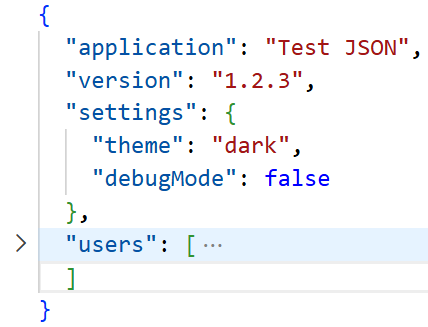
However, the SyntaxEditor still shows the last item in the list, when you click on the - button:
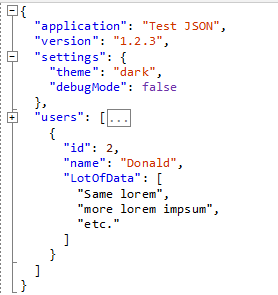
This can be a bit confusing, when said item contains a lot of data.
This seems to happen when both { } and [ ] are used or maybe because they are nested.
Maybe related problem
In addition, the - buttons seem to be one line 'too high up':
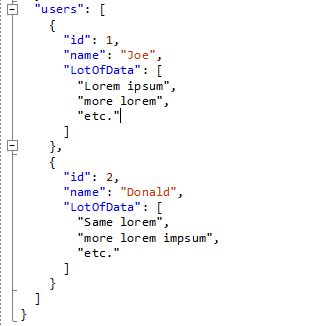
(Should probably be on the same line as the opening { character)
When I have some JSON, e.g.
{
  "application": "Test JSON",
  "version": "1.2.3",
  "settings": {
    "theme": "dark",
    "debugMode": false
  },
  "users": [
    {
      "id": 1,
      "name": "Joe",
      "LotOfData": [
        "Lorem ipsum",
        "more lorem",
        "etc."
      ]
    },
    {
      "id": 2,
      "name": "Donald",
      "LotOfData": [
        "Same lorem",
        "more lorem impsum",
        "etc."
      ]
    }
  ]
}
and I then collapse users, I expect all its children to be hidden.
For example in Visual Studio Code it would then look like this:
However, the SyntaxEditor still shows the last item in the list, when you click on the - button:
This can be a bit confusing, when said item contains a lot of data.
This seems to happen when both { } and [ ] are used or maybe because they are nested.
Maybe related problem
In addition, the - buttons seem to be one line 'too high up':
(Should probably be on the same line as the opening { character)
Nadya | Tech Support Engineer
Telerik team
answered
on
14 Oct 2026
2 answers
83 views
Hello,
I'm signing a PDF field with a signature using the "SignExistingField" that exists in the PdfStreamSigner (Telerik version 2026.2.520.462)
I can see the signature in the field but the signature properties that i set ex: Reason, will show allways empty.
Thanks

Yoan
Telerik team
answered
on
05 Oct 2026
1 answer
26 views
Hi Telerik,
I'm working with an older, obsolete 2024.3.924 , version of the ImageEditor tool and need to set the zoom value in the TextBox to Auto. Currently, the default is 100%
The ZoomFactor property seems to set the Zoom of the slider control and not the image.
private float_defaultEditorScale {get;set;} = 0.60f;
...
ImageEditor.ZoomFactor = new SizeF(_defaultEditorScale, _defaultEditorScale);
Also tried the Tools property viewer. This value is overwritten somewhere along the line.
Thanks,
Dave
I'm working with an older, obsolete 2024.3.924 , version of the ImageEditor tool and need to set the zoom value in the TextBox to Auto. Currently, the default is 100%
The ZoomFactor property seems to set the Zoom of the slider control and not the image.
private float_defaultEditorScale {get;set;} = 0.60f;
...
ImageEditor.ZoomFactor = new SizeF(_defaultEditorScale, _defaultEditorScale);
Also tried the Tools property viewer. This value is overwritten somewhere along the line.
Thanks,
Dave

Dinko | Tech Support Engineer
Telerik team
answered
on
23 Sep 2026
2 answers
60 views
Hello,
I would like to ask two questions about the RadWizard control.
1. How can I edit wizard pages in the designer in a normal way? I found out that the only way is to open "Edit Pages" from the SmartTag, select a page there, and not click OK. If I click OK, the designer always switches back to the first (welcome) page. This does not feel very intuitive.
2. How can I set name of pages? In the designer I don't see any option to set the page name (Name property or field name). In the background I see that it creates wizardPage1, wizardPage2, etc., and I can rename them manually, but I don't see any option for this in the designer. Is it available somewhere?
I need this for step validation. Right now I have something like this, and the documentation also shows it this way:
private void radWizard1_Next(object sender, WizardCancelEventArgs e)
{
    //if (radWizard1.SelectedPage == radWizard1.Pages[1])
    //{
    //    if (!ValidateStep1())
    //        e.Cancel = true;
    //}

    if (radWizard1.SelectedPage == radWizard1.Pages[2])
    {
        if (!ValidateStep2())
            e.Cancel = true;
    }

    if (radWizard1.SelectedPage == wizardPage1x)
    {
        if (!ValidateStep1())
            e.Cancel = true;
    }
}
But using fixed page indexes does not seem right to me. It would be better to set names for the pages, and then use something like radWizard1.SelectedPage == wizardPage1x or radWizard1.SelectedPage.Name == "xxx". I have attached a test project. Thanks.




1 answer
54 views
I'm working with a Winforms grid that may, or may not, have paging set. I need to open a popup editor and edit a record. After I save, I need to pull the data from the database again (other people may have made changes on other workstations) and want the grid to return to the position it was at when the use edit the record.
Given the layout below where only Rows C, D, and E are visible, if the user edits Row D and then saves, I want the grid to look exactly like this with D as the current row.
Row A
Row B
----------
Row C
Row D (edited row)
Row E
----------
Row F
Here is what I tried but its not working as I expected.
int currentRow = gvMemos.CurrentCell.RowIndex;
int scrollPos = gvMemos.TableElement.VScrollBar.Value;

//Do something

if (scrollPos > 0)
    gvMemos.TableElement.VScrollBar.Value = scrollPos;

if (currentRow > 0)
{
    gvMemos.TableElement.ScrollToRow(currentRow);
    gvMemos.CurrentRow = gvMemos.Rows[currentRow];
    //gvMemos.CurrentRow.EnsureVisible();
}
Thanks
Carl
Nadya | Tech Support Engineer
Telerik team
answered
on
08 Sep 2026
2 answers
112 views
I have a hierarchical grid that looks like this:
However, I need it to look like this:
I need the two tabs with the caption table to follow one another on the 3rd level rather than exist side-by-side. How do I accomplish this?
Thanks
Carl