Highlighting the Current Line Number in RadSyntaxEditor
Environment
| Product Version | Product | Author |
|---|---|---|
| 2025.1.415 | RadSyntaxEditor for WinForms | Dinko Krastev |
Description
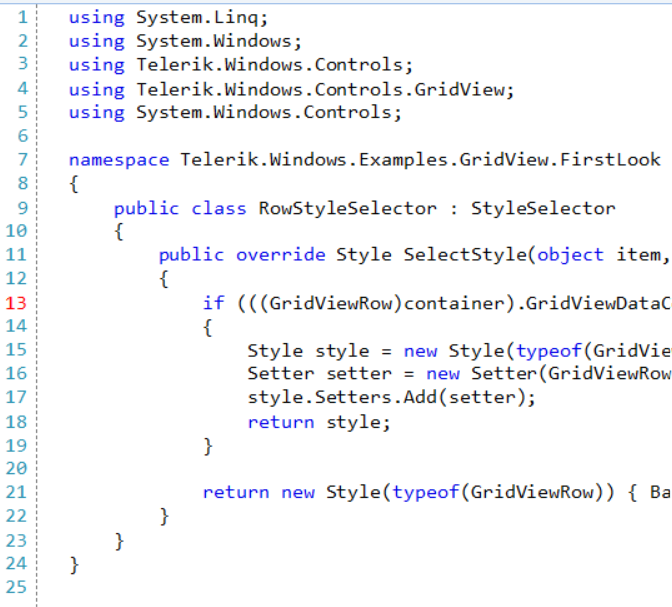
By default, the RadSyntaxEditor line number margin displays all line numbers in the same color. This article demonstrates how to create a custom line number margin that highlights the current line number with a different color so that users can easily identify which line the caret is on.
Solution
To achieve this, create a custom class that inherits from LineNumberMargin and override its UpdateUIOverride method. Inside the override, compare each line number block's vertical position with the caret position to determine which line is the current one and change its foreground color accordingly.
Step 1: Create the custom HighlightedLineNumberMargin class
public class HighlightedLineNumberMargin : LineNumberMargin
{
    private Brush currentLineBrush;
    private int currentLineNumber = -1;

    public HighlightedLineNumberMargin(RadSyntaxEditorElement syntaxEditor)
        : base(syntaxEditor)
    {
        this.currentLineBrush = new SolidBrush(System.Drawing.Color.Black);
        this.Editor.CaretPosition.PositionChanged += this.OnCaretPositionChanged;
    }

    public Brush CurrentLineBrush
    {
        get { return this.currentLineBrush; }
        set { this.currentLineBrush = value; }
    }

    private void OnCaretPositionChanged(object sender, EventArgs e)
    {
        int newLine = this.Editor.CaretPosition.LineNumber;
        if (newLine != this.currentLineNumber)
        {
            this.currentLineNumber = newLine;
            this.UpdateUI();
        }
    }

    protected override void UpdateUIOverride(UIUpdateContext updateContext)
    {
        base.UpdateUIOverride(updateContext);

        var caretPos = this.Editor.GetPointFromPosition(this.Editor.CaretPosition);

        foreach (UIElement child in this.Canvas.Children)
        {
            TextBlock block = child as TextBlock;
            if (block == null)
                continue;

            double blockY = Canvas.GetTop(block);
            bool isCurrentLine = Math.Abs(blockY - caretPos.Y) < 1.0;
            block.Foreground = isCurrentLine ? this.CurrentLineBrush : this.NumbersBrush;
        }
        this.Invalidate();
    }

    protected override void DisposeManagedResources()
    {
        if (this.Editor != null)
        {
            this.Editor.CaretPosition.PositionChanged -= this.OnCaretPositionChanged;
        }
        base.DisposeManagedResources();
    }
}
Step 2: Replace the default line number margin with the custom one
// Remove the default line number margin
var defaultMargin = radSyntaxEditor1.SyntaxEditorElement.Margins.ScrollableLeft
    .OfType<LineNumberMargin>().FirstOrDefault();
if (defaultMargin != null)
{
    radSyntaxEditor1.SyntaxEditorElement.Margins.ScrollableLeft.Remove(defaultMargin);
}

// Add the custom margin with the desired highlight color
var highlightedMargin = new HighlightedLineNumberMargin(radSyntaxEditor1.SyntaxEditorElement);
highlightedMargin.CurrentLineBrush = new SolidBrush(Color.Red);
radSyntaxEditor1.SyntaxEditorElement.Margins.ScrollableLeft.Insert(0, highlightedMargin);
The current line number will now be rendered in the specified CurrentLineBrush color (red in this example), while all other line numbers retain their default appearance.