Strongest Area
Get My Full Results

See how your organization compares with 800+ engineering professionals from the Progress and SlashData AI Engineering in 2026 report.
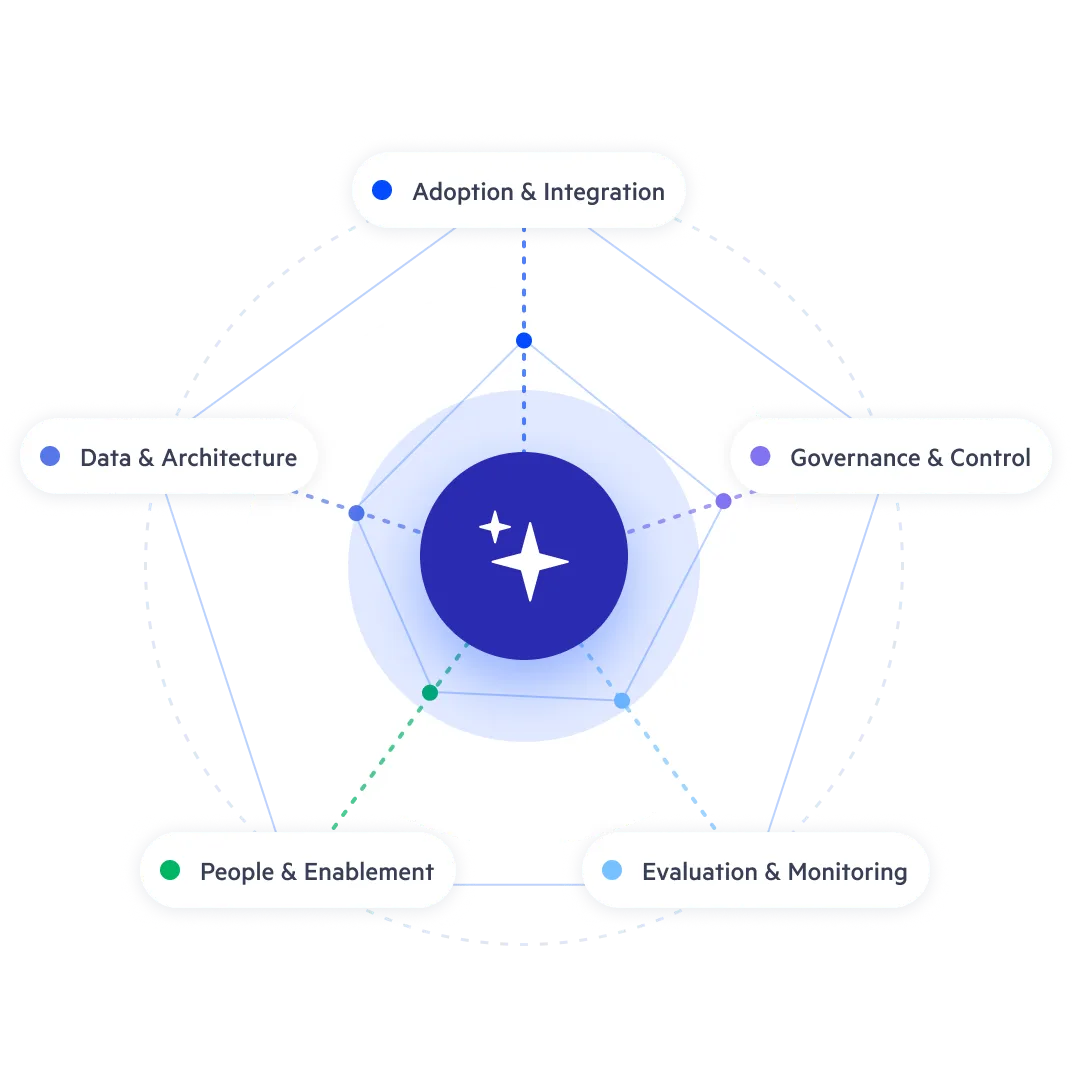
Your five dimension scores show how your AI engineering practices compare across the areas that make up the AI Engineering Maturity Index.
Your maturity score becomes more useful when you can see it in context.
You’re at the start of your AI engineering journey. AI activity is beginning to emerge, but practices remain informal or depend on individual teams. Your biggest opportunity now is to focus on the right use cases, build shared knowledge and put some basic standards and ownership in place.
Your organization is at the beginning of its AI engineering journey. AI activity is emerging, but practices are still largely informal, fragmented or dependent on individual teams.
At this stage, the priority is not to scale AI everywhere. It is to build enough shared knowledge, ownership and technical discipline to identify the use cases worth taking further.
The next step is to move from isolated experimentation toward a more deliberate engineering approach - with clearer use cases, shared standards and basic governance in place.
You’ve moved beyond curiosity and are actively testing what AI can do for your organization. The next step is to turn promising pilots into repeatable engineering practices, with a clearer and more reliable path to production.
Your organization has moved beyond curiosity and is actively prototyping or piloting AI.
You are beginning to learn what works, but successful outcomes may still depend on individual projects, teams or people. The challenge now is repeatability.
The next step is to turn promising experiments into shared engineering patterns, so teams have a clearer and more reliable route from prototype to production.
You’ve established repeatable ways to build and deploy AI. Your next challenge is making sure evaluation, governance and operational controls keep pace as AI adoption expands across your organization.
Your organization has moved beyond isolated AI experiments and established repeatable ways to build and deploy AI.
That puts you at an important transition point: the challenge is no longer proving that AI can work. It is making sure the engineering practices around it are strong enough to support broader production use.
As adoption grows, your next stage of maturity will depend on how consistently you can evaluate AI behavior, govern its use, monitor it in production and operate it reliably at scale.
You’re operating AI through established engineering practices and at meaningful scale. The opportunity now is to strengthen resilience, efficiency and control as your AI systems become more numerous, interconnected and autonomous.
Your organization has established systematic engineering practices for building and operating AI in production.
You have moved beyond repeatability into a stage where AI systems are becoming part of normal engineering operations. The challenge now is not simply to deploy more AI, but to operate it reliably, efficiently and with increasing control.
As AI workloads become more numerous and autonomous, the next stage of maturity depends on strengthening resilience, economics and operational discipline without slowing innovation.
AI engineering is already an established capability across your organization. Your focus now is on staying ahead: continuously evolving your architecture, governance, economics and operational controls as AI becomes more capable and more deeply embedded in the business
AI engineering is an established organizational capability, supported by mature practices across development, production and operations.
At this stage, the challenge is no longer adoption or basic scale. It is maintaining maturity as AI systems become more capable, more autonomous and more deeply embedded across the business.
Your focus shifts toward continuous improvement: evolving architecture, governance, economics and operational controls so that your ability to trust and manage AI keeps pace with what the technology can do.
Your responses did not provide enough information for us to create an accurate assessment.
If you're unsure about a question, try selecting the answer that most closely matches your current understanding instead of choosing "Don't know" too often.
If you opted in, check your inbox for your full assessment results, including recommendations and resources based on your maturity stage, strongest area and biggest opportunity.
or choose one of these — they clear other selections or choose
Select at least one answer to continue.
We use this only to compare you with similar organizations in the research.