Styling and Formatting Reports
Extended Text Formatting through HTML
Telerik Reporting supports inserting HTML-formatted content directly into the report via the HtmlTextBox item to produce customizable and good looking results. The HTML value can be specified at design time (either through a WYSIWYG or an expression editor). It can also retrieve content directly from a data source by using any expression that evaluates to correctly formatted HTML. Various formatting options that are available to control the text presentation are:
- Font, size, color
- Bold, Italic, Underline
- Lists
- Paragraphs
- Inline styles (background, border, color, font, padding)
Formatted text can be rendered to HTML, PDF, and Image formats, in Silverlight, WPF, WinForms and ASP.NET applications. The HtmlTextBox item also supports injecting complex expressions into the HTML-formatted text for mail merge functionality.
enlarge screenshot
Fine-Grained CSS-like Styling
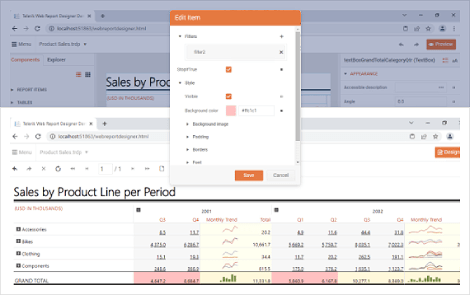
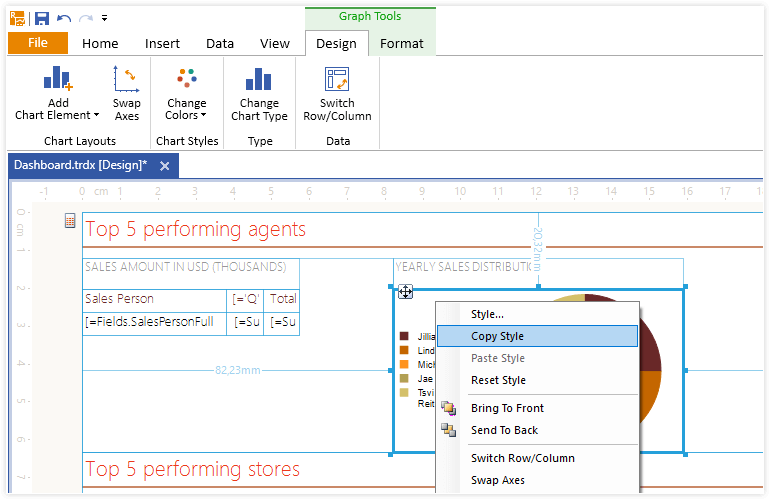
Telerik Reporting introduces an advanced and much enriched styling mechanism through its built-in styling model, which closely follows CSS specifications. This model provides for quicker and very fine-grained visual customization of all reporting controls, all in the Visual Studio designer. This CSS-like mechanism offers full control over the item’s background, images, colors, borders, styles, paddings, etc.
You can assign styles to one or more reporting items by using the known CSS selectors: Type, Attribute, Style, and Descendant. Styles can also be applied globally and then saved to an external file for later use. If extra control over visual appearance is needed, cascading styles can be applied manually.
External style sheets can be referenced from local path, relative path, resource, and/or URL for extra flexibility when using style sheets.
enlarge screenshot
Conditional Formatting
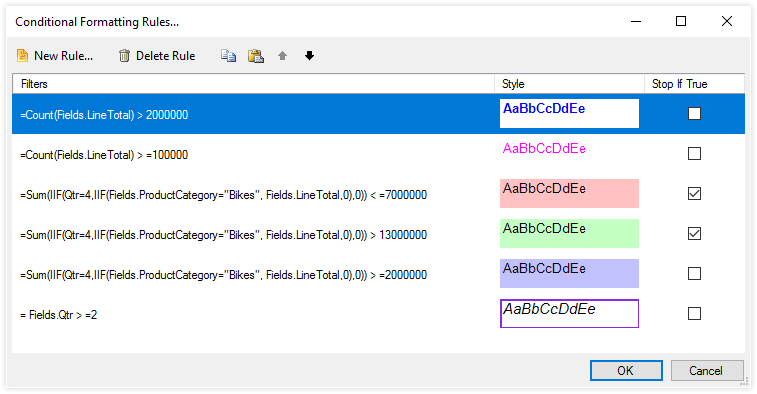
Formatting your reports, based on pre-defined conditions is made extremely simple through the Microsoft Excel©-like functionality directly in the Visual Studio design-time. It offers codeless generation of rules and uses the efficient styling mechanism of Telerik Reporting to tweak the colors, fonts, and background presentation of your data.
enlarge screenshot
Report Globalization
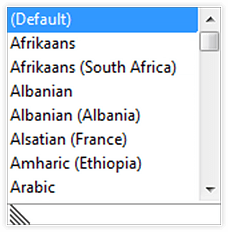
Due to business globalization, the need of multi-lingual and culturally aware applications is a requirement. Telerik Reporting is culturally aware and you can use more than one culture for your reports at the same time. The cultures can be applied to the whole report or to specific items.
Culture determines the way date, time, numbers and currencies are displayed, and specifies the appropriate text direction (LTR or RTL). This means that Telerik Reporting can be used with any RTL language, such as Hebrew and Arabic. Globalization is fully supported in all export formats (HTML, TIFF, PDF, Excel).
In addition, all Telerik reports are localizable. Localization is controlled through the Localizable property of the report, much like the standard .NET controls.

Rich Set of Measurement Units
A typical challenge in report design is the precise layout and sizing of elements for the purposes of proper printing and viewing in different formats. Telerik Reporting supports a variety of measurement units, which can be used for any element, including borders, padding, and even font sizes. Examples:
Font.Size=1cm
BorderWidth.Left=2in
You can also use combinations of different measurement units where appropriate. A default report measurement unit allows you to quickly enter dimensions and positions without specifying the unit.
Reuse of Corporate Design and Branding
Telerik Reporting introduces an advanced and rich styling mechanism through its built-in styling model, which closely follows CSS specifications. This CSS-like mechanism offers full control over the item’s background, images, colors, borders, styles, paddings, etc. Once created, just save your corporate design as a new theme and reuse it each time a new report is needed.
Dynamic Layout
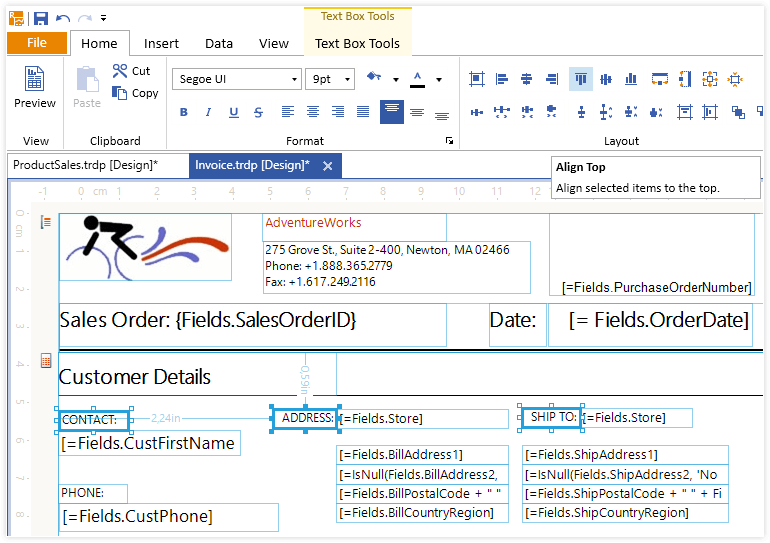
Telerik Reporting offers a brilliant way to providing dynamic layouts by docking and anchoring report items:
- Docking a report item causes its edges to adhere to the edges of its container. When a report item is docked to the edge of its container, it is always positioned to flush against that edge when the container is resized.
- Anchoring is used to dynamically resize report items with their container. It keeps the distance between the edge of the report item and the corresponding edge of the container in which it is anchored.

Format Builder
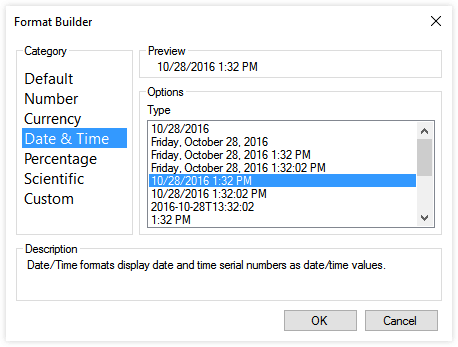
Following established usability standards, Telerik Reporting features a Format Builder which will assist you in formatting numbers and dates in Microsoft Excel© fashion. From decimals to currency, from dates and times to custom formats, the Format Builder supports them all.
enlarge screenshot